

When you are painting a bare wood surface, it is almost a requirement to apply primer to the surface first.
Some DIYers, however, don’t even know that, yet it is super important because primer allows the paint to adhere to the wooden surface more effectively than if it wasn’t by itself.
If you are familiar with cooking, it is sort of like adding the egg wash to have the breading stick to your meat in a deep fryer.
Additionally, a primer gives your paint better coverage and a smoother finish, making your finished product look better. Plus, some primers will seal the bare wood from moisture and erosion. So primers can also be great sealers for people who may not specifically care about looks.
Best Primers for Bare Wood
So what primer is the best for your woodworking project? Well, this is hard to say, as every project is different, and every wood primer is even more diverse.
However, I decided to test a few different types of primers to see what the best wood primer is in general. After trying them out, here are my top favorite primers for your timber that should work for most projects.
1. KILZ General Purpose Exterior Latex Primer
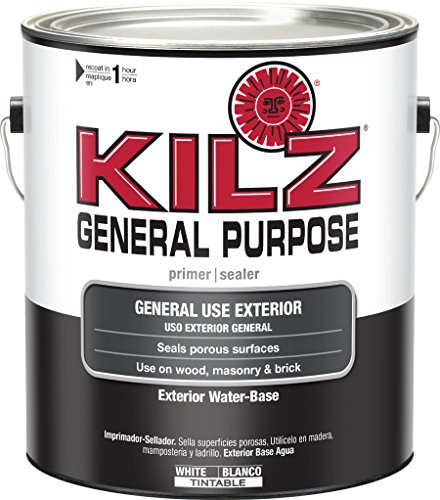
- This fast-drying latex primer and sealer is specifically formulated...
- KILZ General Purpose Primer seals porous surfaces and offers excellent...
- Use on almost all exterior surfaces including stucco, wood, masonry...
*Last update on 2026-03-30 / Affiliate links / Images from Amazon Product Advertising API
The KILZ General Purpose Exterior Latex Primer is the best primer, hands down, that I have tested.
This will seal and protect all your bare wood from the elements and have it primed for painting in about one hour. And although the name doesn’t say it, it is a two-in-one, a primer, and a sealer.
A common occurrence that I say is that primers tend to be relatively smelly. But this one lacked that strong chemical smell that is associated with primers.
One of the best factors about this primer is that it is a general primer, meaning it can be used on nearly anything, maybe your old pine wood furniture or masonry – this gives it the flexibility that the competitors simply lack.
Due to all of these factors and the fact I have nothing bad to say about it, this KILZ primer is the best wood primer for most situations no matter whether it’s a bare wooden surface or the one you stripped before refinishing.
| Pros | Cons |
| • Excellent adhesion • Seals porous surfaces • Primer & sealer in one • Low odor and fast-drying • Covers 300-400 square feet per gallon | • Not for stain-blocking • Not good for flooring or glossy surfaces |
2. Diamond Brite Paint Oil Base Primer

*Last update on 2026-03-30 / Affiliate links / Images from Amazon Product Advertising API
If for some reason, you don’t want to use my first choice, the Diamond Brite Paint Oil Base Primer is a great alternative, maybe a little better in some cases.
It is great on wood, but it can be used on many other materials, even metal. But keep in mind that as it is oil, it sadly will only work with the oil-based paint counterparts. This isn’t a big deal, but something to consider when you plan to buy this primer.
One thing I did notice is how great it was at covering the area. It felt like one coat was nearly enough for most situations, as a single gallon covered just over 300 square feet for us.
But the elephant in the room is the waiting time – it is an oil-based product that takes a long time to dry. They say you should wait about 24 hours to recoat the surface, which is a decade compared to any of the other primers I used. So, I can’t recommend this product if you have a hard deadline you have to meet in a short amount of time.
| Pros | Cons |
| • Durable • Brush, roll, or spray • Offer good coverage • Easy to apply and clean up • Can be applied to a variety of surfaces | • Can be used with oil paint |
3. Krylon ColorMaster Paint + Primer
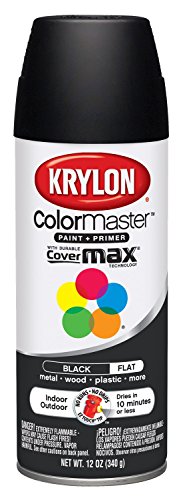
- For use on plastic, metal, wood and more
- Perfect for indoor and outdoor projects
- Dries in 10 minutes or less
*Last update on 2026-03-30 / Affiliate links / Images from Amazon Product Advertising API
Many times your project requires you to paint and prime something in a very short amount of time, and the best primer on this list is the Krylon ColorMaster Paint + Primer for this kind of project.
This primer by Krylon comes in a spray can, meaning it can be applied very quickly to small areas. Also, I found it to be fully dry to the touch in 10 minutes so it surely worked for me very well in saving a significant amount of time.
Honestly, this solid product can be used on nearly everything I tested, from plastic to wood to metal, and it’s relatively cheap.
My only complaint with this spray primer and paint product is that it was a spray can. Although some people may see this as a positive, a spray can is not the way to go if you want to prime a large amount of surface area. But if it is a small object, this works great for what it is.
| Pros | Cons |
| • Highly durable • Spray with no mess • Fast drying in less than 10 min • Can be used on different materials • Premium coverage with brilliant color | • Shine issues |
4. Rust-Oleum Zinsser Bulls Eye 1-2-3 Primer

- Designed for interior and exterior surfaces
- Bonds to glossy surfaces without scuff sanding
- 35°F low application temperature
*Last update on 2026-03-30 / Affiliate links / Images from Amazon Product Advertising API
This Rust-Oleum product is just a solid product all around as it can be used inside and outside wood surfaces, with a short one-hour drying time.
It even has a built-in function where it resists mildew and mold, increasing the lifespan of your woodworking project. Also, it works on glossy surfaces, which some primers sometimes struggle to do.
If you make any mistakes, it is a water-based primer, meaning you can easily clean up with soap and water.
My only complaint is the price tag, but you get what you paid for. Overall, it’s a good pick, and there isn’t much bad to say about the performance of this product.
| Pros | Cons |
| • Water-based • Does not need sanding • Easy to use and clean up • Covers 100 sq. ft. per quart • Good for resisting mildew growth • Dry fast with no blistering and flaking | • Expensive |
5. Rust-Oleum American Accents Ultra Cover Primer
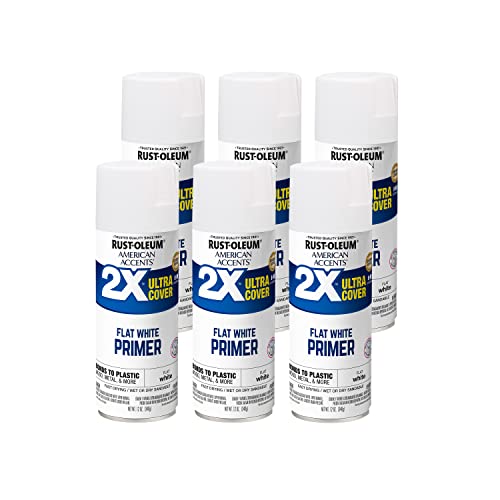
- Ideal for interior/exterior use on virtually any surface including...
- Provides long lasting protection with any-angle spray comfort tip that...
- Dries to the touch in 20 min and covers up to 12 sq. ft. for quick...
*Last update on 2026-03-30 / Affiliate links / Images from Amazon Product Advertising API
Although I just covered a Rust-Oleum product above, here is another one you can consider, in case the above one isnt available.
This Rust-Oleum Ultra Cover Primer is similar to the other primers on my list, but this one is in a spray can. And it was incredibly cheap. That’s all you have to know.
It also has a quicker drying time of about 20 minutes and can adhere to most surfaces. In fact, there wasn’t a surface I tested that didn’t work.
The biggest complaint, however, I have is that it has quite a low coverage, as it covers only 12 feet. This is unacceptable on any project that’s not tiny.
| Pros | Cons |
| • Fast drying • Highly durable • Easy and affordable to use • Good for small-sized projects • Sprayer that can reach hard-to-paint places | • Smelly • Meant for only 12 sq ft |
6. Zinsser Cover Stain Interior/Exterior Oil Primer Sealer
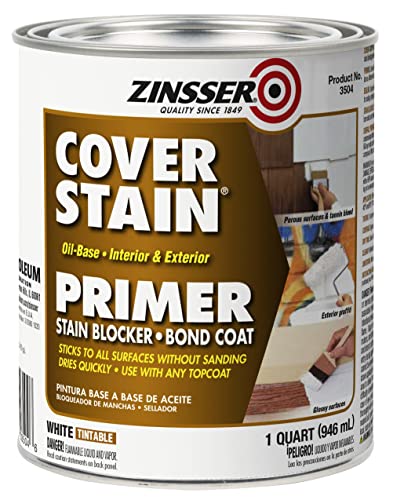
- Cover stain, QT, Oil based stain killer primer/sealer
- Adds extra shine to your product
- Manufactured in United States
*Last update on 2026-03-30 / Affiliate links / Images from Amazon Product Advertising API
Sadly, we are at the point in the list where the primers have gotten pretty similar, so here we will try to mix it up.
The Zinsser Cover Stain Interior/Exterior Oil Primer’s whole idea is that it is a stain hider. It can hide nearly anything from smoke to water stains or even water damage on stained or varnished wood.
Although it can hide nearly anything, due to the nature of the liquid, it requires many coats, which, as you know, takes a lot more time. If this product could be a one-coat primer, this would be closer to the top.
| Pros | Cons |
| • Covers stain • Adds extra shine • Dries in about 1 hour • Oil-based for a variety of surface | • Thick • Not good coverage |
7. INSL-X Stix Acrylic Waterborne Bonding Primer
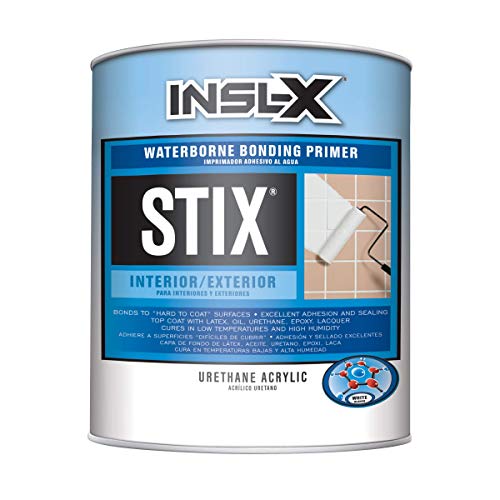
- Premium-quality, acrylic-urethane bonding primer-sealer with...
- Bonding primer for drywall, plaster, ceiling, acoustical tile, wood...
- Bonds to "hard-to-coat" surfaces and can be top coated with almost any...
*Last update on 2026-03-30 / Affiliate links / Images from Amazon Product Advertising API
And the final primer I will recommend is probably the most niche.
The INSL-X Stix Acrylic Waterborne Bonding Primer was designed to be a primer for the more complex surfaces to prime, such as wooden trims, PVC pipes, vinyl, or even glossy tile.
Some primers are just unable to adhere to these unique and challenging surfaces, but the INSL-X had no troubles. However, it is relatively expensive and takes a few hours to recoat.
If, for some reason, the other primers didn’t work for your project, this is a great last resort. Just be aware that, this should not be used for below-grade applications and over Kynar (or similar finishes).
| Pros | Cons |
| • Low VOC • Easy to clean up • Offers great coverage • Bonds to “hard-to-coat” surfaces | • Expensive |
Wood Primer Buying Guide: Factors to Consider
I can proudly say that all the above are great products that will work for unfinished cabinets, doors, windows, old trims, cedar siding, porch floors, decking planks, or any other outdoor wood furniture. Pick one of them out and test it for yourself; hopefully, you will agree with my opinions.
However, if you can’t decide which primer to get, try answering a few questions first which will help you decide better.
1- What type of wood is it?
Remember, there isn’t one primer that works on everything; some cases need a special primer for their particular case. For instance, each type of wood has unique properties, and one of the unique properties is how they take primer.
I agree, that determining what type of species the wood is can be tricky if it is older; however, it shouldn’t be an issue on a new bare project.
If you still haven’t chosen your wood for the project, you may consider basing the wood choice on the project. For example, if you want wood that is easy to prime and paint and can hold the coating for a long time, woods such as redwood, red cedar, bald cypress, white pine, and sugar pine will be the best for you.
If the wood doesn’t need to hold the paint, you may want to consider spruce, hemlock, Douglas fir, ponderosa, or lodgepole pine.
2- What condition is your wood in?
While this isn’t the major concern for bare wood, if you are refinishing an old surface check if your wood is in good condition or if it’s weathered/deteriorated.
A primer is more of a preventive measure rather than a fix, so you may want to consider replacing the wood if it’s severely damaged, rotted, or structurally unsound.
Before choosing a wood primer also think about the weather conditions this wood will experience – like your stained fence wood outside. If it should be rained on consistently, make sure you get a stain-blocking primer that will seal the wood as well as stain.
3- Has the wood been painted or primed before?
These are two huge factors that will affect your choice significantly.
If the wood was primed before, you might be able to get away with using it and just painting it after some sanding.
But if it was painted as well, it gets a little more complicated as you will then need to select the primer that can work on top of an already-painted piece of wood.
If it is possible, and assuming the paint is still adhered well, determine what type of paint is on the wood and do some additional research on what will work well with your specific combination.

Oil-Based vs. Water-Based Primer for Bare Wood Surface
If the wood is bare or untreated, having never been stained or painted, its naturally porous surface allows you to choose between a latex primer or an oil-based primer.
However, if you wish to get superior stain-blocking and adhesion properties it’s certainly a good idea to go with an oil-based primer, especially on high-tannin woods like cedar or redwood. Water-based primers are easier to clean and will have lower VOCs so they are a great choice if you prioritize convenience and environmental friendliness.
Also, if you are priming on cheaper composite wood materials like plywood boards, particle boards, or MDF, it’s good to provide them extra protection by using an oil-based primer. Water-based primer may work poorly on these surfaces as it seeps into the pores and gets absorbed into the material, causing them to swell.
In general, oil-based primer is ideal for wood projects that require a strong, protective seal, while water-based primer is better suited for indoor areas with minimal exposure to moisture. Since oil-based paint releases more VOCs than water-based paint, it is generally less suitable for indoor use.
The main downside of choosing oil-based wood primers is they come at an extra cost and will take more time to dry. So, if you are short on time and/or money, you should probably choose the best quality water-based primer.
| Feature | Water-Based Primer | Oil-Based Primer |
|---|---|---|
| Best for | General use, low-VOC areas | Wood surfaces, sealing stains |
| Application | Provides a smooth base for paint | Seals wood grains, prevents bubbling |
| Shine and Finish | Lacks in strength and shine | Better shine and tougher finish that resist flaking |
| Drying Time | Dries faster | Dries slower |
| Cleanup | Easy to clean with water | Requires special solutions (e.g., mineral spirits, turpentine) |
| VOC Emissions | Low | High, not ideal for indoor use |
How to Apply the Wood Primer and What Kind of Brush to Use?
Priming wood might not be the most exciting DIY task, but trust me—it’s the secret sauce to a smooth, professional-looking finish.
Do it right, and your paint job will last longer than your neighbor’s gossip. Here’s how to get it done efficiently:
Step 1: Clean the wood
Dust, dirt, and greasy fingerprints are the enemy here. So, before you even think about priming, give that wooden surface a good clean using a damp cloth or mild detergent if needed.
Step 2: Pick your tools
If you’re covering a large area, a roller or sprayer can save time (and sanity). But for small projects, a good-quality angled brush will do the trick because precision is key.
When selecting a brush, keep in mind that not all brushes are created equal, and using the wrong one is like eating soup with a fork—frustrating and messy.
If you want to apply water-based primers go for synthetic bristles (nylon/polyester) for a smoother finish. However, for oil-based primers natural bristle brushes hold and distribute thicker primers better.
Step 3: Pick your primer
If you haven’t still narrowed it down, just go with my best primer – the KILZ General Purpose Exterior Latex Primer.
When buying primers remember that they usually come with a short shelf life, and they get dried soon once opened. So, unless you are pretty sure about the quantity, you should avoid buying in bulk.
As a general rule, you should carefully estimate your requirements and buy a little bit more than you actually require. You can get an idea by knowing the overall area you want to primer and the number of coats you plan to apply.
Again, how many coats of wood primer you will need to apply will largely depend on your project and the level of protection you desire to achieve. For example, if you are applying the primer on exterior wood surfaces, you will definitely need to apply more coats than on interior surfaces.
Step 4: Apply the primer and let it dry
Now comes the fun part—load your brush or roller and apply the primer evenly, following the wood grain (unless you like streaks and brush marks, which I highly doubt).
After you are done don’t rush it—let the primer dry completely. This usually takes 2–4 hours for water-based and up to 24 hours for oil-based primers. Use this time wisely—maybe grab a snack, catch up on your favorite show, or just stare at your masterpiece in progress.
Step 5: Light sanding followed by a second coat
If you run your hand over the primed surface and it feels rougher than your morning stubble, it’s time to sand lightly with fine-grit sandpaper (#120 to #150). This step ensures a silky-smooth base. Wipe off the dust with a tack cloth before moving on.
Want an even better finish? Apply a second coat of primer. This will give your topcoat extra grip, making the final paint job flawless and long-lasting. Let it dry thoroughly before moving to the final paint layer.
The Bottom Line
I noted this a few times throughout this article, but I will say one more time that there is not one primer that will work in every scenario. There are some good undercoats, though, that will work in most situations.
For example, I loved the KILZ General Purpose Exterior Latex Primer due to the quality it brings. It’s not only a primer but also an excellent sealer, so it will be a good option for most outside projects as well. This primer precisely also dries relatively fast, making it a solid choice for most bare wood projects.
However, if you need something other than KILZ, check out the primer options I mentioned in my favorite list, as one of them may find a nice spot for itself in your garage. So, go out and choose your primer for your project – whether it is pine, oak, cypress, or any other raw unfinished wood.
Share the post "The Best Primers for Bare Wood [2026 Top Picks]"


With Radon warnings and sealers out there, it can send your head into a spin about whether this is all Read more

We all love MDF for our various projects, including furniture and cabinets. After all, it's cost-effective compared to other wood Read more

For those who want their walls to have a unique appearance, glow-in-the-dark paint is one way to express creativity. As Read more

For over two hundred years, the Valspar brand has been associated with quality. Starting in 1806, the company grew into Read more

Jack Luis is a semi-retired painter who loved painting his clients’ ideas on their walls.
He had worked as a painter for over a decade serving customers in areas such as Charleston, Mount Pleasant, Beaufort, and Georgetown, SC (South Carolina). Today in his free time, he likes to read and write about the newer techniques implemented in his profession. You may read more about him here or get in touch with him here.