
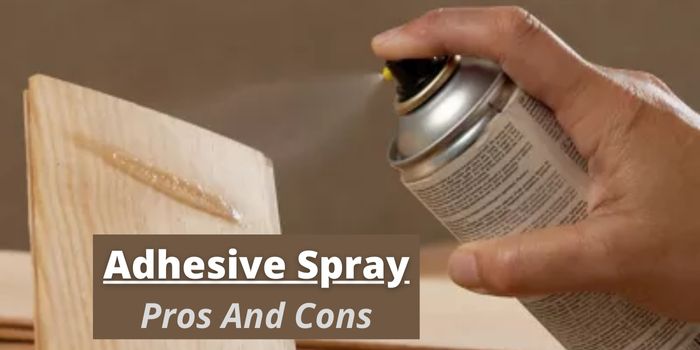
As in the name, an adhesive spray is a typical glue that comes in an aerosol canister and can be sprayed onto surfaces to bond them together.
Sprayable adhesives are different from traditional white glue because they are mostly water-based and will soak deeply into the material being glued to create a stronger bond that lasts for a long time.
But over time, I’ve realized that this convenience isn’t always without consequences. From precision challenges to durability concerns, adhesive sprays have more to them than meets the eye.
So, here’s a closer look at these special adhesives, their common types, where they shine—and where they fall short.
Types of Spray Adhesives
Spray adhesives are often the quiet workhorses behind clean, uniform bonding—especially when you want coverage without the mess of brushes or rollers.
A quick, even mist can bond a surprising range of materials, including wood veneers, paper, cardboard, fabrics, foams, vinyl, and certain plastics.
That makes them a natural fit for crafts, décor work, school projects, and light repairs like reattaching upholstery, fixing leather goods, or handling minor furniture touch-ups.
But be aware that not all spray adhesives are created equal—what’s inside the can determines everything from bond strength to flexibility, open time, and substrate compatibility.
Broadly, they can be categorized based on their chemical composition and carrier system:
1. Rubber-Based (Elastomeric Adhesives)
These are among the most common spray adhesives, typically formulated with synthetic rubbers like styrene-butadiene or neoprene.
They offer excellent tack, flexibility, and quick bonding, making them ideal for porous and flexible materials such as paper, cardboard, fabric, foam, and leather.
Their ability to remain slightly elastic after curing helps absorb minor stresses, which is useful in upholstery and craft applications.
2. Solvent-Based Adhesives
In these systems, the adhesive polymers are dissolved in organic solvents. Once sprayed, the solvent rapidly evaporates, leaving behind a strong bond.
These adhesives generally provide higher bond strength and better heat resistance compared to water-based options, and they adhere well to less porous materials like plastics, laminates, foam, and even some metals.
The trade-off is the strong fumes, flammability, and the need for proper ventilation during use.
3. Water-Based Adhesives
Often called “eco-friendlier” alternatives, these use water as the carrier instead of solvents. They emit lower VOCs (volatile organic compounds) and are safer for indoor use.
They work well with porous materials like wood, paper, and fabric, but typically have longer drying times and lower initial tack.
They’re best suited for applications where environmental considerations outweigh the need for instant bonding strength.
4. Epoxy-Based (Specialized Systems)
True epoxy spray adhesives are less common and usually fall into two-component or activated systems rather than simple aerosol sprays.
When used, they offer exceptional bond strength, chemical resistance, and durability, making them suitable for metals, glass, ceramics, and high-performance applications.
However, they require more precise handling, controlled mixing (in some cases), and are rarely the go-to choice for casual or DIY use.
Advantages of Spray Adhesive
From hands-on use, the real superpower of spray adhesives is their combination of application speed and film uniformity.
Unlike liquid adhesives—which tend to puddle, wick into porous substrates, or create uneven bond lines—spray systems atomize the adhesive into a fine, controlled mist, forming a thin, consistent coating.
This uniform film minimizes localized saturation, reducing issues like substrate warping (especially in paper, textiles, and lightweight laminates) and improving surface wetting and contact area.
It’s precisely why spray adhesives are a go-to choice for lamination, artwork mounting, veneer application, and other surface bonding tasks where finish quality matters.
Below are the key advantages, with some practical nuance:
1. Rapid Tack and Bond Formation
Spray adhesives are typically formulated with fast-evaporating solvents and pressure-sensitive polymers, allowing them to achieve tack within seconds to minutes.
This makes them ideal for time-sensitive workflows or for substrates that shouldn’t remain wet for long (e.g., paper, foam, or fabric).
In many cases, they function as contact adhesives, bonding almost instantly once two coated surfaces meet.
2. Clean Application and Transparent Finish
Because the adhesive is delivered as an aerosolized mist, it produces a thin, even layer without drips or stringing, significantly reducing cleanup.
Most formulations dry clear, which is critical for visible applications like graphics, crafts, and upholstery. That said, overspray control is essential—what you don’t see can still stick.
3. High Surface Coverage with Efficient Material Use
Spray adhesives excel at covering large or irregular surfaces quickly.
The atomization ensures adhesive reaches fine contours and textures, improving mechanical interlocking and adhesion consistency.
This efficiency often translates to lower material consumption per unit area compared to brush- or bead-applied adhesives.
4. Adequate Bond Strength (Within Design Limits)
When applied correctly—proper distance, coating weight, and open time—spray adhesives can deliver reliable bonding for light- to medium-duty applications.
However, they are generally not engineered for high structural loads, especially under continuous shear, peel stress, or dynamic loading.
For structural bonding (e.g., load-bearing joints in wood or metal), epoxies or polyurethane adhesives are more appropriate.
5. Repositionability and Flexibility
Many spray adhesives are designed with a temporary or repositionable tack window, allowing for fine alignment before full bond set.
Additionally, the cured adhesive layer tends to remain slightly flexible, which is advantageous when bonding dissimilar or flexible materials that may expand, contract, or deform during use.
6. Environmental Resistance (With Caveats)
Certain spray adhesive formulations offer moderate resistance to moisture and temperature variations, making them suitable for indoor environments with occasional exposure to humidity or heat.
That said, most are not designed for prolonged exposure to high temperatures or harsh outdoor conditions. Extended thermal cycling or UV exposure can degrade the adhesive layer over time.
7. Ease of Use, Storage, and Wide Availability
From a usability standpoint, spray adhesives are about as straightforward as it gets: shake, aim, spray. No mixing, no tools, minimal setup.
They are also self-contained systems, stored in pressurized canisters with relatively long shelf lives when kept under recommended conditions.
Spray adhesives are also readily available across hardware stores, craft retailers, and online platforms, with a broad range of formulations tailored to specific materials—paper, foam, fabric, plastics, and more.
This accessibility makes them a practical choice for both DIY users and professionals working under tight timelines.
Disadvantages of Spray Adhesives
Convenience, as it turns out, is not the same as capability. Spray adhesives are engineered primarily for non-structural, thin-film bonding, and their performance envelope reflects that.
They excel when loads are low, surfaces are properly prepared (clean, dry, and slightly textured), and bond lines remain thin and uniform.
Even higher-performance aerosol formulations—often used for installing insulation boards, acoustic panels, or lightweight assemblies—are still limited by lower cohesive strength and reduced resistance to sustained shear or peel forces.
In applications involving continuous load, vibration, or elevated temperatures, the adhesive layer can creep, soften, or fail altogether.
In those scenarios, mechanical fastening systems or structural-grade adhesives (e.g., epoxies, polyurethanes) remain the more dependable choice.
Beyond these inherent limitations, there are several practical drawbacks worth factoring in:
1. Flammability and Cost Considerations
Most spray adhesives rely on volatile organic solvents and propellants, making them highly flammable during application and curing. This imposes handling restrictions, especially in enclosed or spark-prone environments.
They also tend to be more expensive per usable gram of adhesive, partly due to aerosol packaging and overspray losses.
2. Health and Ventilation Risks
The same solvents that enable rapid drying can also release VOC emissions that are harmful when inhaled.
Prolonged or repeated exposure—particularly in poorly ventilated spaces—may lead to respiratory irritation, գլխ-headedness, or longer-term health concerns.
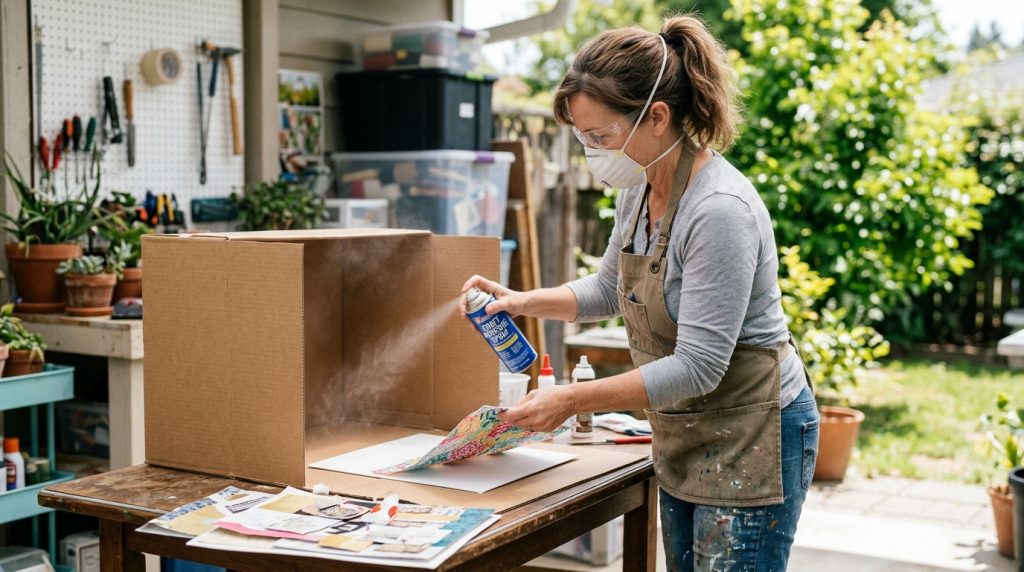
Proper use typically requires adequate ventilation, and in some cases, respiratory protection.
3. Application Sensitivity and Surface Defects
Spray adhesives are deceptively easy to use but highly sensitive to application technique—including spray distance, angle, coating thickness, and open time.
Improper application can result in:
- Over-application, leading to soak-through, staining, or surface discoloration
- Uneven coating, reducing bond strength
- Localized saturation, which can still cause warping in delicate substrates
4. Limited Load-Bearing Capability
As noted earlier, these adhesives are not suitable for high-load or pressure-intensive applications.
Their thin-film nature inherently limits gap-filling ability and load distribution, making them unsuitable for heavy assemblies, structural joints, or components under sustained compression or shear.
5. Environmental Impact and End-of-Life Challenges
From an environmental standpoint, spray adhesives are not particularly elegant. They often contain VOC-heavy formulations and non-recyclable aerosol canisters, contributing to their environmental footprint.
Additionally, once applied, they can be difficult to remove cleanly, which complicates material recycling, rework, or surface restoration.
Adhesive residue can interfere with downstream processes like repainting or re-lamination.
How to Use an Adhesive Spray Correctly?
An adhesive spray is straightforward – simply point and spray onto the desired surface.
- It’s important to start by ensuring that both surfaces are clean and free of any dirt or debris before spraying. Otherwise, the glue will not adhere properly.
- Once cleaned, spray the adhesive, evenly covering the entire surface area you want to be bonded together.
- After the adhesive spray is applied, press the two surfaces together and hold for a few seconds until dry.
For best results, it’s recommended to let the bond cure for 24 hours before using or moving the glued item.
Spray adhesive usually takes about 15-20 seconds to become tacky, but check the canister’s label for specific drying times, which may alter depending on the brand or type of glue.

What’s the Strongest Spray Adhesive on the Market?
Well, there is no best or strongest adhesive spray on the market since it really depends on what you’ll be using it for.
If you need an adhesive spray for something like crafting, then any general-purpose glue will do just fine.
But if you need a stronger bond for heavier materials like wood or metal, you’ll want to look for an industrial-strength glue.
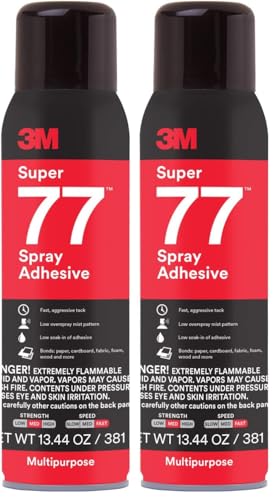
Some of the most popular brands of adhesive sprays I have worked with include 3M Super 77 and GORILLA Heavy Duty Spray Glue. I have used them for a variety of projects, and they have never failed me yet.
I have also heard good things about Loctite’s adhesive spray products, but I have not personally used them before.
All these spray adhesives offer high-strength bonding, but in my opinion, the 3M Super 77 can be considered to be the strongest on the market.
It is a versatile, all-purpose adhesive that can bond together a wide range of materials like paper, cardboard, fabric, and plastics.
If you need a substitute – 3M, Rubber And Vinyl 80 Spray Adhesive is a good one. It’s specially formulated for bonding rubber and vinyl to metal, glass, wood, and plastic.
- The information below is per-pack only
- VERSATILE ADHESIVE: Bonds a wide range of lightweight materials (i.e.,...
- INDUSTRIAL GRADE: Provides professional, industrial strength for...
*Last update on 2026-03-30 / Affiliate links / Images from Amazon Product Advertising API
Choosing the Right Spray Adhesive for Your Specific Project
Since there are tons of different spray adhesive brands on the market, each with its unique benefits and drawbacks, it’s essential to select the best one for the job at hand.
Here are some crucial factors for you to keep in mind when making your selection:
a) Intended use – First and foremost, you need to think about what you will be using the adhesive spray for.
Are you bonding two pieces of fabric together? Attaching a poster to a wall? Applying a decal to a car?
The intended use and type of surfaces you’re working with will help you narrow down your options and choose the best spray adhesive for the job.
b) Drying time – There are many adhesives that dry very quickly, while others take a bit longer.
Think about how long you have to work with the adhesive and choose one that will give you enough time to position the surfaces before it dries. longer.
c) Strength – Spray adhesives’ bond can vary significantly based on the brand you pick.
Some spray adhesives are stronger than others, so if you’re working with heavier materials or need a very strong bond, be sure to choose an adhesive that can provide it.
d) Price – Of course, price is always a consideration when choosing any product, but it should not compromise your project.
Adhesive spray ranges in price from around $5 to $20 per can, so choose one that fits your budget and needs.
The bottom line
Spray adhesives are best thought of as precision surface-bonding tools, not universal solutions.
When used within their intended scope—thin-film bonding, large-area coverage, and quick assembly—they’re remarkably effective.
Push them into structural territory, however, and they’ll politely (or not so politely) remind you of their limits.
Share the post "Adhesive Sprays – The Pros and Cons"


With Radon warnings and sealers out there, it can send your head into a spin about whether this is all Read more

We all love MDF for our various projects, including furniture and cabinets. After all, it's cost-effective compared to other wood Read more

For those who want their walls to have a unique appearance, glow-in-the-dark paint is one way to express creativity. As Read more

For over two hundred years, the Valspar brand has been associated with quality. Starting in 1806, the company grew into Read more

Jack Luis is a semi-retired painter who loved painting his clients’ ideas on their walls.
He had worked as a painter for over a decade serving customers in areas such as Charleston, Mount Pleasant, Beaufort, and Georgetown, SC (South Carolina). Today in his free time, he likes to read and write about the newer techniques implemented in his profession. You may read more about him here or get in touch with him here.