

Despite its simple name, nail hole wood filler is a surprisingly diverse and useful substance. It looks like putty and is available in a variety of different consistencies and textures.
Since it can dry at different rates you can use it for varied needs like for professionally repairing and filling the wood, drywall, or even plaster.
In this guide, I’ll go over some of the best options out there for filling trims (made of MDF wood) and how you should actually use them to fill the nail holes.
Also, I will go through the common uses and types of wood filler so that you can better understand what the product is used for. With that being said, let’s jump right in.
Causes of Nail Holes in Trim
Nail holes in door and window trim can occur due to several reasons.
Firstly, during the installation, if the trim isn’t aligned correctly using the nails or if excessive pressure is applied during installation, it may result in the formation of nail holes.
Additionally, wood trim’s susceptibility to shrinking or expanding due to fluctuations in humidity and temperature can loosen nails over time, resulting in visible holes. Structural settling or frequent usage may also exacerbate this issue, causing trim movement that loosens nails.
Furthermore, poor-quality installation materials or natural deterioration of trim materials can contribute to nail hole development. To mitigate this, prioritize proper installation techniques, employ high-quality materials like MDF, and conduct regular maintenance to address any emerging issues promptly.

The 7 Best Nail Hole MDF Wood Fillers
Choosing the right wood filler is key to success when it’s about filling gaps, cracks, and holes in the MDF wood trim. However, if you are fairly new to the woodworking market, you may not know much about the best available options that can serve your purpose.
The reviews below will hopefully help you find the highly endurable nail hole filler for filling in a trim. Just go through these products and pick the one that suits you best.
1- Minwax 13616000 Wood Putty

- WOOD PUTTY – Minwax Wood Putty is a non-hardening, pre-mixed putty...
- REPAIR CRACKS – The durable wood putty is ideal for filling nail...
- WHITE PUTTY – The oak wood putty is pre-mixed to color-match Minwax...
*Last update on 2026-03-30 / Affiliate links / Images from Amazon Product Advertising API
Manufactured by America’s leading brand (MINWAX) in wood finishing and wood care products, Minwax 13616000 Wood Putty is one of the most popular products on our list for filing tiny holes in wood naturally.
For more than a decade, the products from Minwax have been known for providing better protection to the wood while keeping its natural beauty intact. Without worrying about getting your wood damaged, you can hence use this filler for preparation, cleaning, maintenance, and wood repairs.
I usually love to use this pre-mixed putty to match Minwax wood finish stains as it comes in various different colors like white, cherry, ebony, natural pine, golden oak, and many more. These shades make my task very quick while providing a long-lasting finish by bonding well to the wood permanently.
Right from repairing nail holes in bare wood to fixing gouges and scratches, you can use this non-hardening product without any sanding work. The fact that it does not require any sanding makes this wood filling product very easy to use and clean, even when you want to cover minor defects in painted, stained, or finished wood.
Its available in 3.75-oz and 1-lb packages, so you can choose the one that satisfies your job requirements.
| What I Like | What I Didn’t Like |
| • No need for sanding • Available in various colors • Great for fixing up the small holes • Doesn’t cause any irritation to the skin • Blends perfectly with already stained or painted area | • Takes a long time to dry • Good for only tiny holes |
2- Bondo 20082 Wood Filler
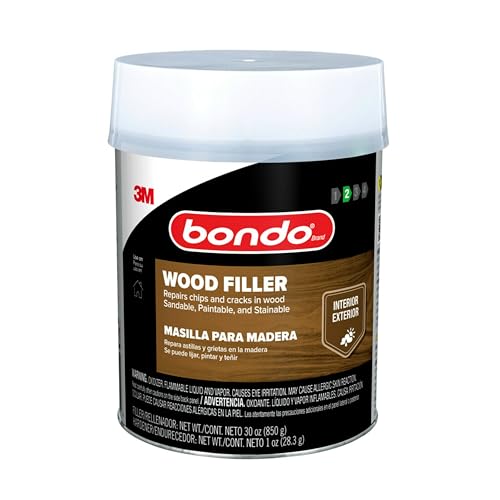
- TWO-PART FORMULA chemically bonds with surface to adhere permanently
- QUICK, DURABLE REPAIRS to damaged and rotted wood
- USE ON MOST WOOD-BASED interior or exterior surfaces
*Last update on 2026-03-30 / Affiliate links / Images from Amazon Product Advertising API
Bondo Home Solutions Wood Filler 20082 is another great choice for people who want to repair or fix nail holes in or around their homes.
Not only to fill the hole in a wood piece, this product works pretty well for fixing cracked drywall also and for filling the edges of the new plywood when making the furniture or cabinet shutters. Once it is dry, it can easily be sanded, planed, drilled, routed, sawed, or shaped just like a real wood piece.
Particularly when you have a low budget for home renovation, you can use Bondo filler for repairing the damaged wood rather than replacing the whole piece of wood.
Available in a 1-quart-can, you can buy this all-purpose Bondo Home Solutions Wood Filler putty with confidence. It’s formulated to paint or stain the wood more naturally than most similar wood-filling products.
The users who used it before claimed that it worked very well for restoring the damaged section of wood on their doors, windows, and fences. Few users however complained about its hardening time which is very less which means you must use it in just a few minutes as soon as it’s mixed. The good thing is its hardening time can be controlled a bit by varying the hardener ratio.
| What I Like | What I Didn’t Like |
| • Easy to use • Dry very fast • Good for fixing holes • Can be used for fixing large areas as well | • Can’t resist water-based stains • Can harden fast even before you apply |
3- Donald Durhams Rockhard Water Putty
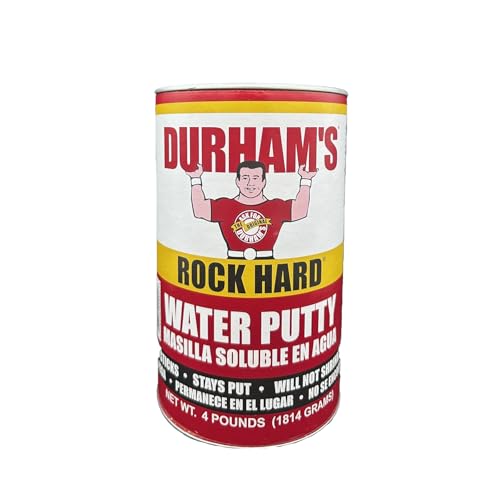
- Water Putty, Makes long lasting repairs in wood, plaster, drywall,...
- Easy To Use, Use indoors or outdoors must be kept painted on outdoor...
- Will Not Shrink and Easy to use and ready when you need it - just add...
*Last update on 2026-03-30 / Affiliate links / Images from Amazon Product Advertising API
As the name implies, Donald Durham’s Putty is a rock-hard water-based putty that can be easily used for patching small holes in the wood.
Homeowners, carpenters, painters, handymen, hobbyists and crafters alike are discovering the versatility of this incredible filler for patching various types of holes and cracks – whether it’s in MDF wood, furniture, plaster, stone, cement, or concrete.
The good thing is that this wood filler includes gypsum which becomes very hard when mixed with water. Its resistant to scratches and also, because of its great bonding strength it does not shrink or crack. Once properly filled this product offers long-lasting, reliable results by maintaining fine details and shapes.
Last but not least, Donald Durham’s Putty is easy to store. Since it comes as a powder (in 1-lb and 4-lb packages), it can last indefinitely, provided you keep it well sealed in its container. As you need, just mix the right quantity in water and try to eliminate the wastage.
| What I Like | What I Didn’t Like |
| • Easy to use water putty • Once set in place, it stays in place • Can be used to fill and repair a variety of surfaces • Comes with great bonding strength and does not shrink | • Not good for outdoor use • Comes only in natural wood color |
4- FamoWood 40022126 Latex Wood Filler
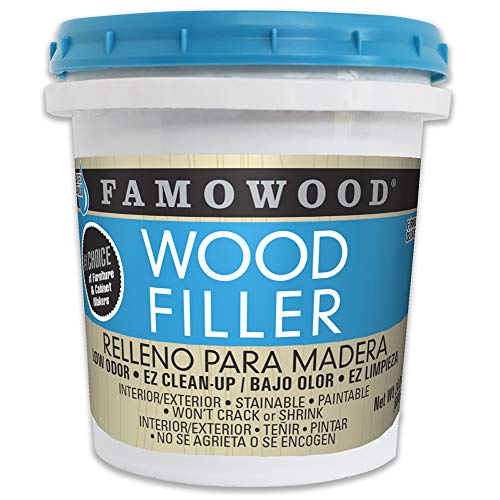
- Dries in 15 minutes
- Won't crack or shrink, solvent free – low odor and easy water...
- Can be sanded, drilled or planed
*Last update on 2026-03-30 / Affiliate links / Images from Amazon Product Advertising API
The brand FamoWood is strictly dedicated to fulfilling the growing demand for wood filler products while creating a negligible impact on the environment.
As a result, FamoWood latex (water-based) wood filler is created that is not only environmentally safe and sound but also one of the top selling on the market. It takes stains and paints like real wood, no matter whether you use it indoors or outdoors.
Also, this non-messy, nontoxic and odorless wood filler for staining is available in 24 Oz. pakage. The good part is it dries within 15 minutes of application, and once dried, it can be sanded, drilled, or planed without any signs of shrinkage, cracking, or crumbling. You can also clean it up quickly just by using soap and water.
| What I Like | What I Didn’t Like |
| • Dries in 15 minutes • Easy to clean, sand, and drill • Good for interior/exterior use • Does not shrink, crack or crumble | • Lid very hard to open • Does not take stain in many cases |
5- Goodfilla Water-Based Wood & Grain Filler
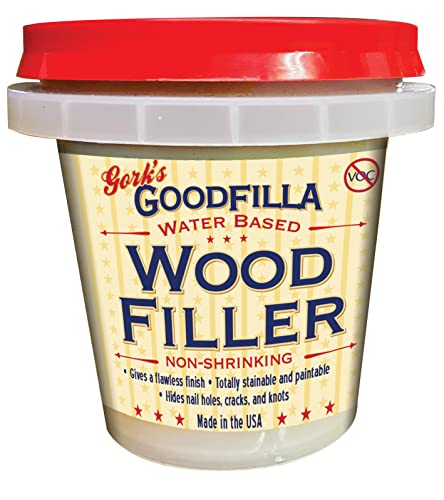
- ⚒️ HIGH QUALITY & MONEY SAVING: Save time and money with this wood...
- ⚒️ DESIGNED FOR PROFESSIONAL WOODWORKERS: This is the most...
- ⚒️ HARDY & CONSISTENT: As any woodworker will tell you, they throw...
*Last update on 2026-03-30 / Affiliate links / Images from Amazon Product Advertising API
Water-Based Wood & Grain Filler by Goodfilla is another great product that can be easily used to fill screw holes in wood and drywall before painting.
The good thing about this white nail hole filler is its quick drying time and excellent adhesion to the wood surface. This means that only with one application you can expect a flawless finish that does not shrink, sink, or crack after you paint or stain.
Available in a variety of sizes and colors, you can pick this USA-made Goodfilla wood filler for your everyday DIY use or even for professional purposes like repairing indoor and outdoor furniture, finishing floors, etc. Since it’s completely non-toxic, green, and comes with zero VOC emission it offers you a peace of mind for an efficient project completion.
| What I Like | What I Didn’t Like |
| • Innovative and easy-to-use • Comes with unlimited shelf life • Easy to sand, non-toxic, and zero wastage • Satisfaction guarantee, refund up to 365 days • Can be mixed with any pigment, tint, stain, or dye | • Smells bad for many • Issues with packaging • Not good for large holes |
6- Erase-A-Hole Repair Putty for Wood & Drywall

- FAST, EASY WALL REPAIR — Instantly fills nail holes, screw holes,...
- SMOOTH, PAINTABLE FINISH — Quick-drying formula blends seamlessly...
- MESS-FREE, PORTABLE DESIGN — Compact, twist-up applicator lets you...
*Last update on 2026-03-30 / Affiliate links / Images from Amazon Product Advertising API
If you want to quickly fill those ugly holes (in your walls, plaster or wood) without wasting any time and energy, Erase-A-Hole is one of the quickest and easiest applicators available on the market.
Available in a tube stick, it’s a special blend of ingredients that won’t shrink or crack, even while sanding. This means that all your DIY repairs stay fixed for a longer time with this wood and drywall repair putty.
One good thing that I loved while using this easy-to-use handheld filler was its compactness. I can keep this thing in my handyman toolbox to use it wherever and whenever required.
You can also fit this Erase-A-Hole filler in your toolbelt or painter’s pants to fill the pinholes and plaster wall cracks quickly when repainting your walls. Simply apply it in a circular motion and then wipe it down with a damp cloth. Your wall is ready for a repaint.
| What I Like | What I Didn’t Like |
| • Handheld compact applicator • Fills all the holes and cracks in a flash • Minimizes shrinking and withstands sanding • Easy to use and comes with a two-year guarantee | • Stick may break if not used correctly |
7- J-B Weld 8257 KwikWood Wood Repair Epoxy Putty Stick
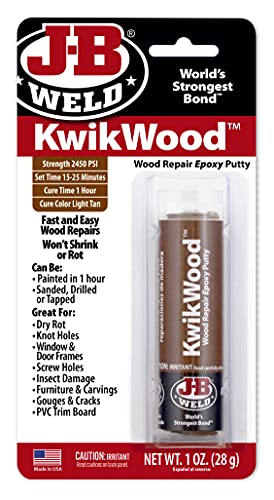
- J-B WELD KWIKWOOD: A hand mixable two part epoxy putty stick that is...
- CURE AND SET TIME: After kneading the two part formula together by...
- PRODUCT FEATURES AND STRENGTH: J-B Weld KwikWood has lap shear...
*Last update on 2026-03-30 / Affiliate links / Images from Amazon Product Advertising API
J-B Weld KwikWood Wood Repair Stick is another great hand-mixable epoxy putty that’s specially formulated to repair and rebuild wood.
From fixing your old cracked chair to filling the holes in a picture frame or filling nail holes in your MDF wood trim, this highly versatile product works amazingly fast. You can even use it for fix dry rot, knot holes, screw holes, insect damage, PVC trim board, gouges & cracks on the window and door frames.
When mixed, applied, dried (within 25-20 minutes) and cured, its long-lasting permanent bond (that is stronger than wood) allows your wood to be easily shaped, tapped, filed, sanded, drilled, and painted.
Overall, JB Weld is a reputed brand known for its heavy-duty adhesives in repairing and restoring wood while woodworking and painting. You can buy and use their J-B Weld KwikWood with all the confidence to DIY fix all types of furniture, wood, and plaster just with a single use.
| What I Like | What I Didn’t Like |
| • Contain no solvent • Dries within 15-20 minutes • Does not shrink, crack or rot • Fix all kinds of holes- small or big | • Bit of smelly • Hard to take the stain |

Common Uses of Wood Filler
If you are planning to use a wood filler for the very first time or wondering how it can help you out in your project, let’s start by discussing some of the most popular wood filler applications.
You may be surprised at just how versatile this product can be in your home renovation job…
1- Filling Holes in the Trim
The first and most obvious use of this product is its ability to fix the small holes in the wood.
Small cracks, nail holes, or even holes made by insects are a common problem in old wooden trims and skirting boards at times when you want to refinish them. No matter how deep a hole you’re trying to fix, you can count on this substance to get the job done fairly quickly and easily.
Even if you see signs of wood rot (yellowish or brown spongy to touch wood), you can easily fix them using a wood filler. When you are done fixing the wood, simply leave it or paint over it to achieve a more natural-looking finish. These small repairs will actually prevent your painted window trim from rotting further.
2- Fixing Old Flooring and Furniture
If your hardwood floor or a piece of old furniture is looking a bit old and grainy, using wood filler to polish and restore its shine could prove to be a good move on your part.
To start, apply a thin coat of an oil-based wood filler onto your floor and give it time to set – avoid water-based wood filler as a floor polish, as it can damage your floors. Once dry and ready, use high-grit sandpaper to buff your floor and restore its shine.
Depending on the type of wood on the flooring and the extent to which it’s damaged, you may also opt to dye, stain, or refinish your floor with a sealant.
Keep in mind that if you are trying to fix your outdoor furniture that’s beginning to rot you will need to first peel away the bit of wood that is beginning to tear away and then replace it with thick heavy-duty wood filler.
For light jobs, wood filler is a great way to restore your furniture to its beauty. But you shouldn’t do this for furniture that bears weight, as wood hardener is generally accepted as a more appropriate substance for the task.
3- Smoothing Wood Grain
Don’t like the look of your hardwood floors? It could be that your wood is made up of long and wide grains that make it appear cheaper and less aesthetically pleasing.
If you find this to be the case, you can put a coat of wood filler over your wood and polish it out so that your MDF wood gains a more premium look. This is a popular technique for hardwoods such as white oak, which tend to be longer and wider and generally less attractive.
You may find it even better to apply a wood stain on top of your wood once you are done with the filler. This should have a nice polished surface that really catches the eye.
Can Wood Filler Be Used In Place of Wood Glue?
Wood filler can get the job done in a pinch as it works as well as wood glue in many cases. Of course, it’s not quite as cheap as wood glue, but it may come in handy if you already have it around.
How to Fill Nail Holes in Wooden Trim?
The holes in your window trims or baseboards may be quite small or rather large, depending on the size and type of nail used. Maybe you can use a putty, caulk, or filler that does the fixation job correctly. But the question comes how do you go about fixing them properly?
What follows are some simple, inexpensive ways to fill in the holes and divots created by the nails in wooden trim so that you can get a smoother surface to repaint them at a later stage.
Step 1 – Consider the Size of the Holes
Start by asking whether it’s worth the effort to fill in the holes in the first place. For those who use an Electric Brad Nailer, for example, that was calibrated to perfection, the size of the divots may not even be noticeable.
While all nail holes are apparent when viewed up close, you should stand at the closest reasonable distance that you expect anyone to see them and judge whether they are worth filling in. You may find that they are virtually invisible, which means that the effort and expense of doing tiny corrections are simply not worth it.
If they are quite small and you are planning on painting the MDF wooden trim, then the paint alone may be enough. But if you find that you can easily see them and they are noticeable, then you are ready for the next step, which is getting the right material to fill in the areas.
Step 2 – Choose Between Water-Based or Solvent-Based Wood Filler
You will need to decide which one is right for your needs, but it is true that water-based versions have some exceptional aspects. These are soft, easy to use, and can be applied quickly.
The downside of water-based wood fillers however is that if you have to spread them over a wide area, they can fall apart. But, considering that nail holes tend to be quite small, this is not much of a downside.
While solvent-based filler is far stronger when it hardens, it’s also more difficult to apply.
Oily, sticky, and messy, cleaning up after using a solvent-based filler will probably have you going for a water-based one the next time out. This is especially true if you are going to cover the trim with white paint or a colored stain.
Unless you need to cover some wide gaps, a water-based filler is generally the best choice.
Step 3 – Prepare a Hole Filler
Well, preparing a wood filler for nail holes isn’t as tough as you may think. To prepare it for the application you will need a wood filler, solvent and a putty spatula.
Depending on the kind of wood filler you pick and the type of wood you want to put it into, the solvent you use can be water-based or alcohol-based (such as thinner). If you want, you can even stain or pigment it using a common wood stain or an enamel.
When ready with your things…
- Mix the right amount of filler with the solvent using a putty spatula or a thin piece of plywood.
- When mixing, ensure that the end result is something like a consistent and malleable putty. It should neither be too diluted nor too dry.
- The right consistency will help in penetrating through the cracks very easily without getting the material wasted.
Remember – once prepared, your MDF wood filler will going to dry very quickly. So, without wasting your time, go and apply it wherever you need to. It’s good to fill even the smallest crack if you have got some excess filler left in the end, rather than going it wasted.
Step 4 – Use Your Finger for Filling
While a putty knife or a spatula has many uses, your finger is arguably far better when it comes to applying MDF wood filler to fix nail holes. Putty knives many times become difficult to use with small holes compared to large surfaces. So, you can save a considerable amount of time and effort by applying a little wood filler to the tip of your finger and smearing it into the nail hole.
Protection should be as important as filling the holes itself. So, it is recommended that you use vinyl or nitrile gloves with MDF wood fillers, as the residue left behind is easier to deal with if you are wearing the right gloves.
Step 5 – Sand the Surface to Get the Better Finishing
After the filler has dried, use a putty spatula or fine sandpaper to gently sand and remove the excess filler. This step is crucial for blending the repaired area with the surrounding surface and achieving a seamless finish. Just remember to sand lightly and gradually to avoid removing too much filler and compromising the finish.
Once finished, use a tack cloth to clean away any remaining material, and then you can start with the wood primer, sealant, stain, or paint that can result in a professional-looking repair.
What are the Different Types of Nail Hole Wood Fillers?
Wood fillers come in varied options some of them being more suitable for indoors while others are specifically formulated for outdoor use.
Indoor wood fillers typically prioritize factors like low odor, quick drying time, minimal shrinkage, and ease of sanding. On the other hand, outdoor wood fillers are designed to withstand harsh weather conditions, UV exposure, and moisture, ensuring durability and longevity.
With this information in mind, let’s now take a more in-depth look at some specific types of wood fillers so that you can get a better idea of which type will work for your project.
a) Solvent-Based
When encountering small holes or gaps in trims, cabinets, or wooden flooring, employing a solvent-based wood filler is an effective solution for concealment.
The application process is straightforward and these wood fillers are available in various hues, allowing for color matching with the timber used. However, it’s important to note that solvent-based wood fillers lack significant structural strength. Therefore, it’s advisable to refrain from driving nails or screws into areas filled with this type.
b) Water-Based
Water-based wood fillers consist of organic materials such as wood fiber, cellulose, and minerals like gypsum. They emit minimal odor due to their low volatile organic compound (VOC) content.
In certain situations, water-based wood fillers are regarded as more adaptable than solvent-based or latex-based alternatives, as they can be easily thinned with water for projects requiring a thinner filler consistency.
Additionally, these fillers offer the benefit of a quick drying time, typically around 15 minutes, and can be effortlessly cleaned up afterward using soap and water.
c) Epoxy-Based Fillers
Epoxy fillers offer added structural integrity and come in clear or colored varieties, typically packaged in cans or tubes. Being water-resistant and quick-drying these are also great for outdoor use for fixing tiny holes in your deck or siding.
Applying this filler can be somewhat messy, but precision is crucial as it’s challenging to sand once it sets. Once dried, epoxy filler provides greater strength than the wood it repairs. While you can insert nails or screws into it, it has a plastic-like look, making it best suited for concealed areas.
Can I Prepare a Homemade Wood Filler?
If you’re unable to find a wood filler that matches the color and texture of the wood you’re working with, you have the option to create your own.
One method involves blending sawdust and shavings with lacquer to produce a paste-like consistency. This homemade filler can be applied and sanded down once it dries, providing a natural appearance if smoothed properly, though it lacks significant structural integrity.
Another approach is to mix wood shavings and sawdust with wood glue. Once applied and dried, this mixture offers better mechanical strength but tends to appear darker than the original wood color. Additionally, it’s tougher to sand compared to the lacquer-based mixture.
Wood Filler vs. Wood Putty: Which is Better for Nail Holes?
While both these terms are interchangeably used in place of one another, wood filler and wood putty are different.
A wood filler is mostly water-based and great due to its malleability. But some of them are also created with chemicals such as latex, clay, lacquer, epoxy, or polyurethane.
One of the advantages of using wood fillers for nail holes is that it is a firmer compound that sets in extremely fast and allows you to sand or stain the product. The best part is that their cure time doesn’t exceed ten minutes.
Wood putty, on the other hand, is obtained with a mix between calcium carbonate and an oil-based compound. It is meant to be used only with oil-based finishes, meaning that it isn’t as malleable as wood fillers are.
One of the pros of using wood putty is the fact that they are incredibly resistant. This means you can use them for outdoor furniture, as they won’t get damaged easily. Also, wood putty is more affordable than wood fillers.
A downside of wood putty is it requires a lot of time to set in. Depending on your project, the cure time for wood putty can range from two days to two weeks.
Is Spackle and Wood Filler the Same?
Spackling compounds and wood fillers are not the same.
While wood filler (and wood putty) is used to fill the holes and gaps in the wood, spackle is majorly used for repairing the holes and cracks in the plaster or wall. In a pinch, you can use products such as caulk, soap, and even toothpaste as these are great alternatives to spackling if you want to fill the small holes and gaps in your wall.
However, if you want to fill the hole in the wood (like a push pin hole, dart hole, etc.), these may not be a reliable option to choose due to the fact that they may shrink and cause a divot over time.
Is There a Wood Filler You Can Screw Into?
Not all fillers are created equal—some are just there to look pretty, while others can take a screw like a champ.
When you need to screw into regular wood fillers won’t work. Your best bet for the task is epoxy wood fillers. These heavy-duty heroes harden into a rock-solid mass that can be sanded, painted, and yes—drilled into without flinching. Just remember: treat it right with a pilot hole, or you will risk cracking its confidence and structure.
Other screw-worthy contenders include two-part fillers like Roxil and solvent-based options like Bondo (which, let’s be honest, is more muscle than filler). Even Durham’s Rock Hard Water Putty lives up to its name—though it’s not exactly known for being flexible, so don’t expect it to do yoga with your screws.
Whichever you pick, the golden rule is – to let it cure completely before going in with tools and always drill smart, not hard.
So yes, you can screw into wood filler—just don’t try it with the soft, squishy stuff meant for nail holes and minor sins. Go big, go epoxy, and screw like a pro.
The Bottom Line
Repairing furniture or other wooden items – or merely building something from scratch – will often make you discover you need to fill some tiny holes. And it is only reasonable to experience such issues, as holes can represent gaps or variances in the MDF wood or where the nails go in.
Knowing this, make sure to use this guide as your ultimate reference for finding the type of wood filler that’s right for you, especially when dealing with MDF trim.
Share the post "The 7 Best Nail Hole Fillers for MDF and Wood Trim"


With Radon warnings and sealers out there, it can send your head into a spin about whether this is all Read more

We all love MDF for our various projects, including furniture and cabinets. After all, it's cost-effective compared to other wood Read more

For those who want their walls to have a unique appearance, glow-in-the-dark paint is one way to express creativity. As Read more

For over two hundred years, the Valspar brand has been associated with quality. Starting in 1806, the company grew into Read more

Jack Luis is a semi-retired painter who loved painting his clients’ ideas on their walls.
He had worked as a painter for over a decade serving customers in areas such as Charleston, Mount Pleasant, Beaufort, and Georgetown, SC (South Carolina). Today in his free time, he likes to read and write about the newer techniques implemented in his profession. You may read more about him here or get in touch with him here.