

Adirondack chairs are the undisputed royalty of outdoor relaxation. But if your trusted lawn thrones have spent a few too many seasons battling intense summer sun, sudden downpours, or freezing winter air, they are likely looking a little worse for wear.
Leaving old wood unprotected is an open invitation for moisture intrusion, cell wall degradation, and structural rot. To save your classic loungers, you need a high-performance barrier that locks out moisture and defends against damaging solar radiation.
Here are the five best sealants to weatherproof old Adirondack chairs, ranked by their technical strengths and performance.
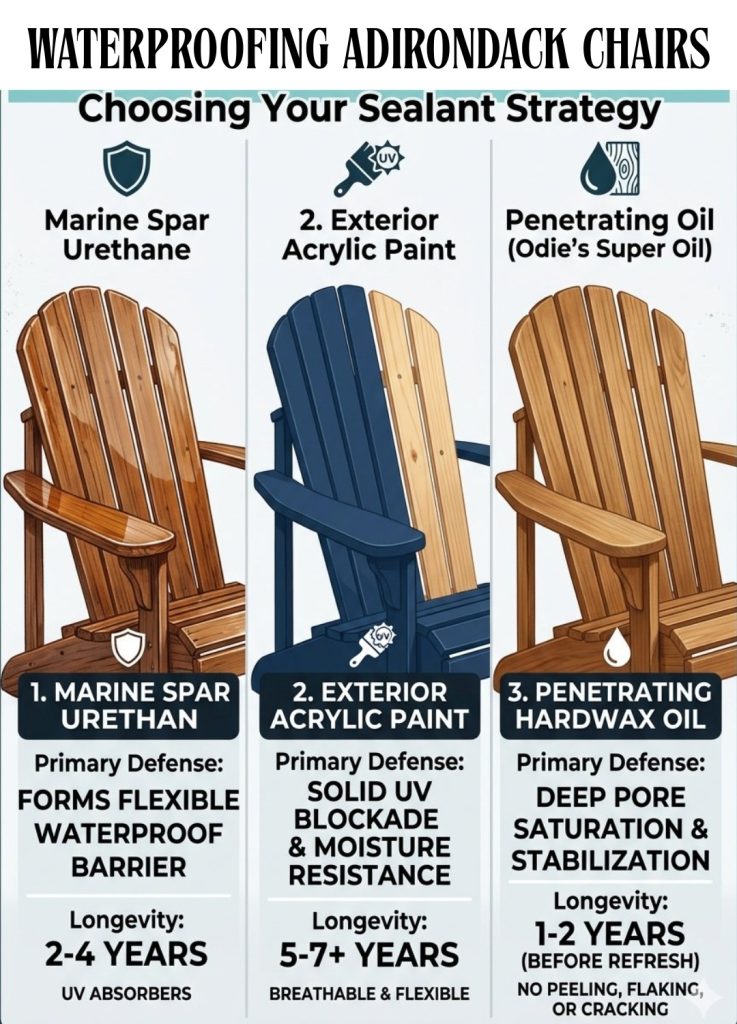
Best Finishes for Waterproofing Adirondack Chairs
Today, people use Adirondack chairs as beach or poolside lounge chairs, patio furniture items, and even for their backyard or garden areas.
Most Adirondack chairs are made of cedar, teak, or mahogany. Unlike pine, oak, bamboo, wicker, or plastic, these woods are naturally resistant to rot and decay and can even be left out in the winter.
However, you must take proper steps to protect them from the elements and last for years. So, here are some of the best finishes for weatherproofing your Adirondack chairs made from natural wood:
1. Marine-Grade Spar Urethane
If you want an invisible, armor-like shield that keeps your chairs looking like natural wood, marine spar urethane is the gold standard.
Unlike standard interior polyurethane—which cures into a rigid, brittle film—spar urethane is formulated with a higher ratio of flexible oil to hard resin. This oil-to-resin ratio ensures the cured coating remains pliable.
When outdoor wood inevitably expands and contracts with daily temperature swings and humidity shifts, the finish moves with it instead of cracking.
Additionally, marine-grade options are packed with specialized UV absorbers. These additives intercept harmful ultraviolet rays, transforming them into harmless heat before they can break down the wood’s natural lignin.
- The Upside: Long-lasting, high gloss or satin options, and incredible moisture exclusion.
- The Downside: It forms a surface film. If moisture gets underneath through a scratch, it can fail locally and require sanding back to bare wood to fix.
2. Exterior Acrylic Latex Paint
If your old chairs are heavily weathered, stained, or mismatched, high-quality exterior acrylic latex paint is the ultimate defensive weapon.
From a purely technical standpoint, pigment is the single most effective UV blocker available. While clear coats eventually let some light pass through, solid paint pigments completely reflect solar radiation, giving your wood maximum longevity.
Furthermore, modern 100% acrylic formulas are highly breathable; they create a hydrophobic barrier against standing rainwater while still allowing internal wood vapor to escape, preventing blisters.
- The Upside: The absolute longest-lasting protection against sun damage; hides deep wood imperfections and stains.
- The Downside: Completely hides the natural beauty of the wood grain.
3. Penetrating Hardwax Oils (Odie’s Super Penetrating Oil)
For the DIYer who hates the plasticky look of heavy varnishes, Odie’s Super Penetrating Oil is a brilliant alternative.
This is a non-film-forming sealant. Instead of sitting on top of the wood, it uses a zero-VOC, solvent-free blend of oils and waxes that migrate deep into the micro-pores of the wood fibers.
By occupying the free space within the wood cell lumens, it stabilizes the timber from the inside out. Because there is no top film, it will never peel, flake, or crack.
- The Upside: Food-safe, incredibly easy to apply, highlights the ultimate depth of the grain, and will never peel.
- The Downside: Offers less aggressive UV protection than a thick marine clear coat or solid paint; requires a secondary top coat (like classic Odie’s Oil) for true long-term exterior defense.
4. Traditional Penetrating Oils (Teak, Linseed, or Tung Oil)
If you are restoring premium dense hardwoods like teak or mahogany, classic penetrating oils are the traditional choice.
Pure tung oil and polymerized linseed oil cure through a process called cross-linking, where the oil reacts with atmospheric oxygen to form a tough, water-resistant polymer mesh inside the wood grain.
Commercial “Teak Oils” are often a blend of these oils, resins, and solvents designed to penetrate deeply into oily woods that reject standard finishes.
- The Upside: Beautiful, classic matte finish that elevates high-end hardwoods.
- The Downside: Zero film protection means they wash out over time. You will need to clean and re-oil the chairs every 6 to 12 months to maintain weatherproofing.
5. Clear Waterproofing Sealers (Silicone/Silooxane Blends)
If your old chairs are made of pressure-treated lumber or basic softwoods and you just want a quick, budget-friendly shield, a penetrating silicone or siloxane sealer fits the bill.
These sealers rely on nanotechnology to bond with the silica in the wood cells, creating a highly hydrophobic surface. Water will bead up and roll right off the arms and slats. However, these are strictly moisture barriers and offer minimal structural reinforcement or UV protection.
- The Upside: Very inexpensive, incredibly fast to spray or brush on, and dries in hours.
- The Downside: Breaks down quickly under direct sunlight; typically requires annual reapplication.

How to Clean and Refinish Your Adirondack Chairs?
Cleaning, restoring, and refinishing your old wooden Adirondack chairs is not so tough. All you need is to follow the detailed steps here…
Cleaning
A pressure washer is a great way to get rid of dirt, grime, and mildew quickly and easily. Here’s how to use one to clean your chair:
- Fill the pressure washer with water and detergent according to the manufacturer’s instructions.
- Turn on the pressure washer and hold the nozzle about 6 inches from the chair’s surface.
- Move the nozzle in a back-and-forth motion until the entire chair is covered.
- Rinse off the chair with clean water and let it air dry.
Pro-Tips for a Flawless Application
The Foot Trick: The absolute most vulnerable part of an Adirondack chair is the bottom of the legs, where the end grain sits directly on damp grass or concrete, wicking up water like a straw.
When weatherproofing, mix up a small batch of waterproof epoxy and dip the bottom 1/8-inch of the chair feet into it. This creates a permanent plastic bootie that halts ground rot completely.
Stir, Never Shake: If you choose a film-forming finish like spar urethane or polyurethane, never shake the can. Shaking introduces micro-bubbles into the liquid that get trapped as the film cures, leaving you with a pitted, rough surface. Stir smoothly with a wooden stick.
Sand Responsibly: Open up the wood cells before applying any oil or sealant by sanding with 120-grit down to 150-grit sandpaper. Avoid going finer than 180-grit on outdoor furniture, or you risk polishing the wood so smooth that the sealant cannot physically grip the fibers.
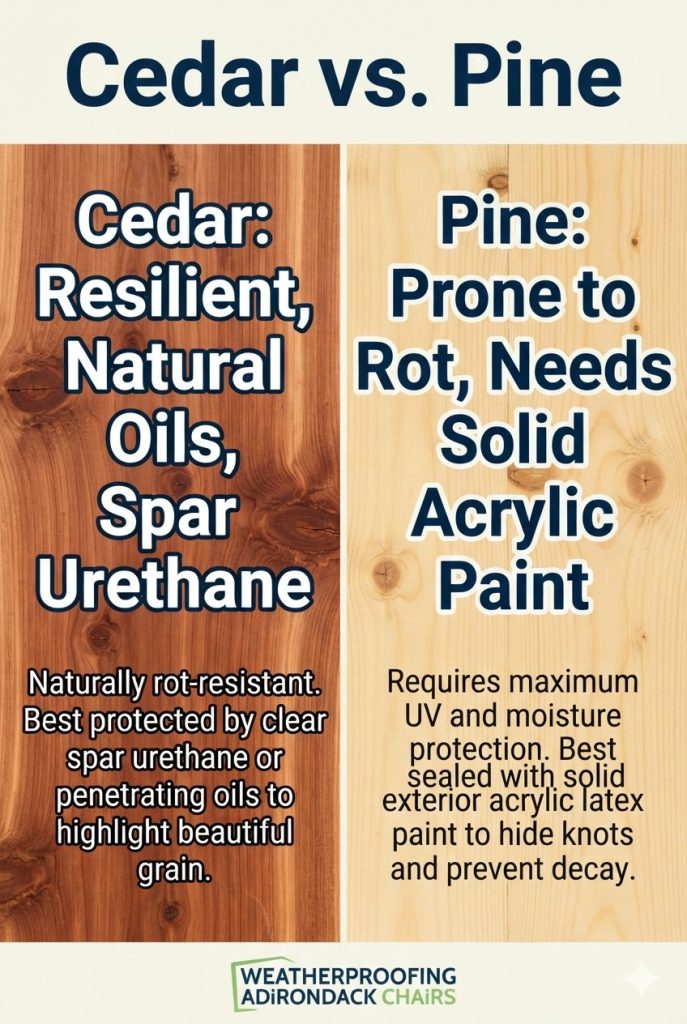
Cedar vs. Pine: The Anatomy of the Wood Dictates Your Sealant Strategy
Not all Adirondack chairs are carved from the same tree, and choosing your sealant without identifying your wood species is a recipe for premature finish failure.
If you are dealing with old chairs, they are almost certainly made of either cedar or pine. Mechanically and chemically, these two woods behave completely differently under outdoor stress.
Here is exactly how to tailor your weatherproofing strategy based on the wood grain you are protecting:
Cedar Chairs: The Natural Survivor
Cedar is the darling of outdoor furniture for a technical reason: it is packed with natural extractives and thujaplicins—organic compounds that act as natural self-defense mechanisms against rot, fungi, and boring insects.
Because cedar naturally resists decay, your primary battle isn’t preventing rot; it’s stopping UV radiation from destroying the wood’s surface lignin and turning it a weathered, silvery gray.
The Finisher’s Dilemma: Cedar is highly porous and dimensionally stable (it doesn’t warp drastically), making it excellent for absorbing penetrating treatments. However, those same natural oils can sometimes bleed through standard paints, causing unsightly brown staining.
The Best Weapon: Odie’s Super Penetrating Oil or a high-quality Marine Spar Urethane works beautifully here. They capitalize on cedar’s natural stability, highlighting the gorgeous reddish-brown hues while locking down the fibers. If you must paint cedar, you must use a dedicated exterior oil-based primer first to lock in the tannins.
Pine Chairs: The Sponge That Needs Armor
Pine is a budget-friendly softwood, but left outdoors unprotected, it is a ticking clock. Unlike cedar, pine lacks natural chemical defenses against moisture and fungal spores. It is incredibly prone to checking (splitting along the grain), warping, and rot if it encounters standing water.
Furthermore, old pine chairs often feature large knots that continually weep sticky sap, which will easily ruin a clear coat from the inside out.
The Finisher’s Dilemma: Pine behaves like a sponge. It absorbs moisture rapidly, meaning it undergoes aggressive dimensional movement (expansion and contraction) between dry afternoons and humid nights. A rigid finish will crack on pine within a single season.
The Best Weapon: Exterior Acrylic Latex Paint is the undisputed champion for pine chairs. The flexible acrylic film stretches as the pine swells, while the solid pigment provides the heavy-duty UV blockade the wood desperately lacks.
Pro-Tip for Pine: Before applying any finish to pine, scrub down any visible wood knots with mineral spirits or denatured alcohol, and seal them specifically with a shellac-based primer (like BIN) to stop the sap from ruining your topcoat.
The Bottom Line
Weatherproofing your old Adirondack chairs isn’t just about making them look good for next weekend’s barbecue—it’s a calculated rescue mission for the wood’s underlying cellular structure.
If you are dealing with a naturally resilient wood like cedar, lean into its strengths with a deep-penetrating treatment like Odie’s Super Penetrating Oil or a flexible clear marine coat to showcase that gorgeous grain.
If you are trying to save a vulnerable softwood like pine, skip the natural look and lock it down under the bulletproof, UV-blocking armor of a premium exterior acrylic latex paint.
Spend the time upfront to clean, sand, and seal those vulnerable chair feet with epoxy, and your outdoor thrones will easily outlast the elements for years to come.
Share the post "5 Best Sealants to Weatherproof Old Adirondack Chairs?"


With Radon warnings and sealers out there, it can send your head into a spin about whether this is all Read more

We all love MDF for our various projects, including furniture and cabinets. After all, it's cost-effective compared to other wood Read more

For those who want their walls to have a unique appearance, glow-in-the-dark paint is one way to express creativity. As Read more

For over two hundred years, the Valspar brand has been associated with quality. Starting in 1806, the company grew into Read more

Jack Luis is a semi-retired painter who loved painting his clients’ ideas on their walls.
He had worked as a painter for over a decade serving customers in areas such as Charleston, Mount Pleasant, Beaufort, and Georgetown, SC (South Carolina). Today in his free time, he likes to read and write about the newer techniques implemented in his profession. You may read more about him here or get in touch with him here.