

Cone sanding is one of the best ways to sand those tiny, detailed, and hard-to-reach areas on your project.
It’s a process that uses a small cone-shaped piece of sandpaper (detail sanding cones) to smooth out the surface.
Designed to slip into narrow spaces and glide along detailed contours, these conical tools bring precision where flat sheets fail.
Whether you’re refining intricate woodwork, touching up metal components, or just tired of fighting stubborn crevices, cone sanding gives you control, accuracy, and surprisingly smooth results.
Let’s break down what it is, how it works, and why your future self might thank you for discovering it.
Cone-Shaped Sanders
If you have ever tried to work on small irregular surfaces of softwood furniture, you know how complicated it is to sand those areas.
Especially for carvers and woodturners, getting into small spaces can be a real challenge.
But with detail cone sanders, now there’s an easy way to get into all those tiny, hard-to-reach areas.
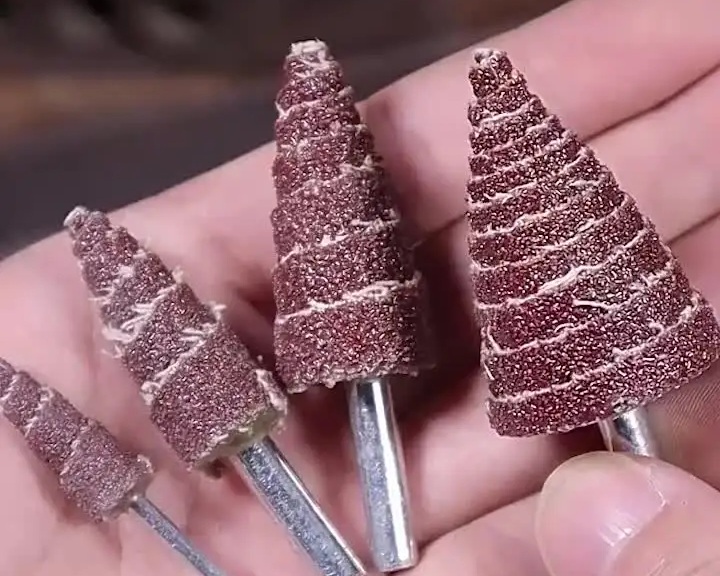
Cone-shaped sanding attachments, often called sanding cones or conical flap wheels, are clever little abrasive tools built for one job: reaching the spots your regular sandpaper wishes it could.
Designed with a tapered, cone-like form, they slip effortlessly into tight corners, carved details, grooves, and other annoying hard-to-reach areas. These cones mount onto rotary tools such as die grinders, drills, or Dremel-style tools via a shank, making them incredibly versatile.
Once spinning, they’re perfect for smoothing, polishing, grinding, shaping, and deburring everything from wood to metal to composites. Available in a range of grits, they’re a favorite among woodcarvers, furniture makers, metalworkers, and DIYers who deal with intricate surfaces.
You can use them for a wide variety of projects, including but not limited to wood carving, making walking canes, sculptures, pyrography, etc.
Sanding Cones Sizes and Grits
The TreelineUSA website offers two sizes of sanding cones – small and large.
The small ones are great for getting into tight spaces, while the large ones are perfect for working on larger surfaces. Both sizes come in a variety of grits, such as 200, 250, 300, and 350.
200 is a medium-grit sander designed for light sanding, whereas 350 is a fine-grit sander that’s ideal for sanding jobs that involve very fine details.
So, depending on your project requirements, you can choose the right sanding cone size and grit.
How to Use the Detail Sanding Cones?
To use your sanding cones, first, attach them to the mandrel by simply slipping the cone onto the mandrel and tightening the set screw.
Once the cone is attached to the mandrel, you can start sanding the surface of your project.
Remember to use light pressure and move the sander in a circular motion to avoid any damage to the surface.
Also, make sure you always sand with the grain of the wood to get a smooth, desirable finish.
The video by TreelineUSA tells you more about these detail sanding cones, how to attach them to the mandrels, and how to carefully sand the surfaces using them.
So, check out these small yet highly functional devices – if you plan to work on a small surface with intricate details and carvings.
Detail Sanding Cones Other Uses and Buying Tips
Although detail sanding cones are mainly used in polishing furniture and products made of wood (like sanding the grooves in your antique chair or table), you can also use them for grinding and buffing artificial stone, glass, plastic, and several other hard or soft surfaces.
If you are wondering where to purchase these devices, TreelineUSA is one of the best online tools and woodworking stores out there.
Treeline was founded in late 1997 and operated out of a small Provo, Utah building until moving to a new 8000-square-foot location west of the original in 2004.
Their primary focus is wood carving tools and materials, walking stick/cane supplies, pyrography equipment, and other hard-to-find tools while maintaining excellent customer service and product quality.
For more information and tips on cone sanding, you can check on the official website of TreelineUSA.com, where these tapered cone sanders are available at a very reasonable cost.
Detail sanding cones by Dremel and a few other brands are also available online. So, if you want, you can compare the prices before buying them, especially if you need to purchase them in bulk.
Polirolls vs. Abrasive Sanding Cones – Are they the Same or Different?
Polirolls and abrasive sanding cones may look similar at a glance, but they are quite different in construction, performance, and ideal use cases.
Abrasive sanding cones are conical tools designed specifically for getting into tight corners, grooves, and fine details.
Their shape allows them to reach spots that flat or cylindrical abrasives can’t access.
They come in multiple sizes and grits, making them useful for delicate woodworking, detailed carving, metalwork, and finishing tasks. Because of their fixed cone shape, they’re excellent for uniform smoothing in narrow or angled areas.
Polirolls, on the other hand, are spirally wound abrasive sleeves made from cloth-backed material with abrasive grains embedded in a resinoid bond.
As they wear down, the spiral design naturally exposes fresh abrasive, giving them a longer working life. Polirolls are more robust and are ideal for shaping contours, refining edges, deburring, and smoothing irregular surfaces.
They shine in metalworking and heavy-duty woodworking tasks where you need efficient material removal but also a clean finish. Unlike fixed-form sanding cones, polirolls come in cylindrical, tapered, and other specialty shapes.
In short, abrasive tapered sanding cones are better for precision detail work, while polirolls are better for continuous, aggressive, and contour-following sanding.
Both can fit rotary tools or die grinders, but their performance differs: cones excel at access and finesse, while polirolls excel at durability and continuous abrasive action.
Share the post "What is Cone Sanding – How it Works?"


From building furniture and refurbishing existing furnishings to touching up the doors, tables, and other wooden pieces in your home, Read more

Getting the best paint job means more than using the right paint. In addition to having good brushes and rollers, Read more

You are in the middle of sanding your walls, and you realize that there are still many more pieces of Read more

I remember the early days when my father, as a painter, did not have many options for spraying the cabinets Read more

Jack Luis is a semi-retired painter who loved painting his clients’ ideas on their walls.
He had worked as a painter for over a decade serving customers in areas such as Charleston, Mount Pleasant, Beaufort, and Georgetown, SC (South Carolina). Today in his free time, he likes to read and write about the newer techniques implemented in his profession. You may read more about him here or get in touch with him here.