

Simply put, anti-climb paint is a coating designed to be so slick that it prevents people and animals from climbing on walls, lamp posts, and other surfaces.
Once applied, the coating remains greasy and transferable, meaning it easily smears onto hands, clothing, and tools. The result is immediate loss of grip—and often a strong reconsideration of the climbing attempt.
If you are excited enough to know more about this paint, how and where to apply it, we have all the details below…
Anti-Climb Paint Composition
Anti-climb paint is formulated with a thick, greasy, and non-drying base that remains permanently slippery.
The composition typically includes heavy mineral oils, petroleum-based greases, and specialized polymers that prevent the coating from hardening.
To improve durability, manufacturers often add thickeners, stabilizers, and weather-resistant additives so the coating withstands rain and temperature changes.
Some formulations also contain dark pigments (usually black) to make the coating visible as a warning. The result is a long-lasting security coating that discourages climbing by eliminating grip rather than causing harm.
How to Apply the Anti-Climb Paint Correctly?
Compared to cameras, motion sensors, or razor wire, anti-climb paint is a remarkably straightforward, passive, low-cost method of strengthening security where vulnerable boundary walls or gates need an extra layer of protection.
To apply anti-climbing paint on the walls or other surfaces, it’s good to use a stiff, disposable paint brush to do the job.
By throwing away the disposable paintbrush, you will not need to clean it later.
The paint can be applied under a wide range of temperatures from just below freezing up to 95 degrees F.
But keep in mind that because the paint is thick and rather gloopy, you will need to apply it quickly for it to be effective.
After the application, be sure to add warning signs that may be required by law based on your location. These signs will also act as a deterrent to all but the most determined intruders.
How many coats of anti-climb paint need to be applied?
Typically, one thick coat of anti-climb paint is sufficient. Since these coatings are designed to remain permanently greasy and slippery, a single, well-applied layer usually provides the intended deterrent.
However, in some cases two coats may be recommended:
- Highly porous surfaces (like rough concrete, brick, or unfinished masonry) may absorb part of the first coat, so a second coat ensures a consistent greasy layer.
- High-risk areas where extra durability is desired.
- When the manufacturer specifically recommends a primer or base coat, followed by the anti-climb layer.
For best results, apply a thick, even coat about 2–3 mm deep on the upper section of the wall or structure—usually the top 6–8 feet of the surface.
This often translates to about 2.5 liters of paint for every square meter that will be painted. But you should always check the specific product instructions, as formulations can vary slightly between manufacturers.
Also, because the climbing-resistant paint is very slippery, you may need to apply a solvent-based floor sealer first before putting on the first coat. This helps the anti-climb paint stick better to the surface.
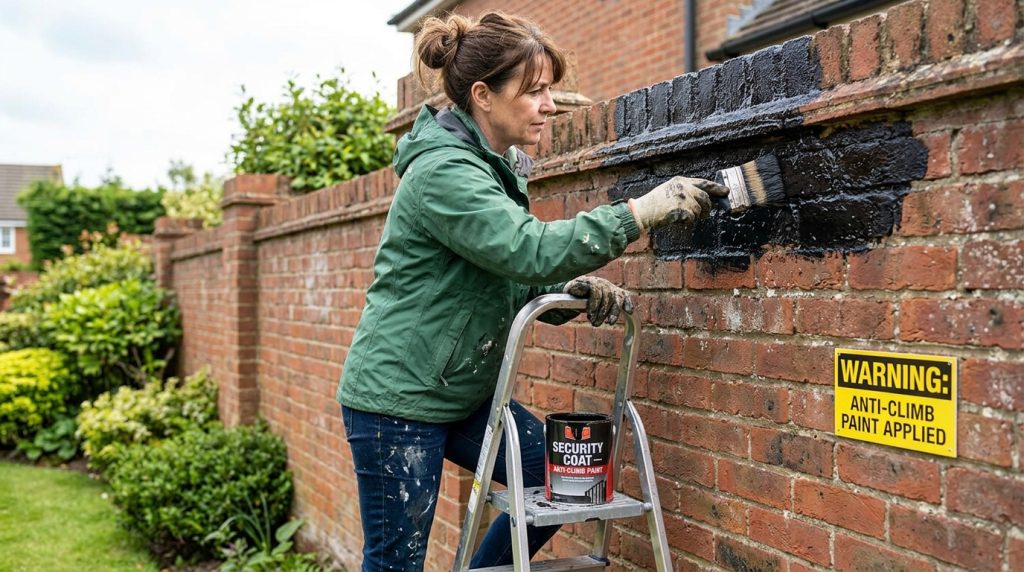
Where Can You Use Anti-Climb Paint for Security?
Because most anti-climb paints are non-toxic, they can be used in a wide range of places for security reasons.
The most logical places to use them are locations where access can be gained to your home, office, church, or facility by climbing a wall.
This also applies to locations where the vantage point gained from climbing offers a suitable place for vandals to spray paint artwork or messages.
Such applications of anti-climb paint also include the following…
- Lighting support posts, security & defense locations
- Poles & posts particularly those that support CCTV equipment
- Commercial environments such as warehouses and industrial facilities
- Scaffolding & drainpipes to prevent access to roofs or high windows
- Schools to protect students from possible injury by dissuading climbing
Besides the above, anti-climb paint can also be used to discourage squirrels and other rodents from climbing trees, poles, or building surfaces, preventing them from reaching roofs, attics, or other areas where they might cause damage.
The lead pipes and copper rooftops of churches have also become a popular target for thieves recently, which is why insurance companies often include requirements for anti-climb paint to be used.
What materials you can paint?
Despite its “wet” properties, anti-climb paint is both non-toxic and non-corrosive. This means it can be applied to many different surfaces, including the following.
- Plastic, Metal, and Wood
- Roof Tiles, Stone, and Slate
- Brick, Concrete, and Fiberglass
Is anti-climb paint safe for pets at home?
While anti-climb paint is generally non-toxic to dogs and cats, it can easily stick to their fur and paws.
Once that happens, the oily residue can be tracked straight into your home—onto floors, carpets, and even furniture.
Unlike humans, animals can’t read warning signs. This can become a particular nuisance if a neighbor’s pet regularly climbs your wall or fence.
A curious cat or an adventurous dog may scale the surface, pick up the sticky coating, and then wander indoors, unintentionally spreading the mess throughout the house.
Also, you should not use anti-climb paint in aquatic locations such as ponds, pools, and the like because it can be harmful to aquatic creatures and other nearby animals.
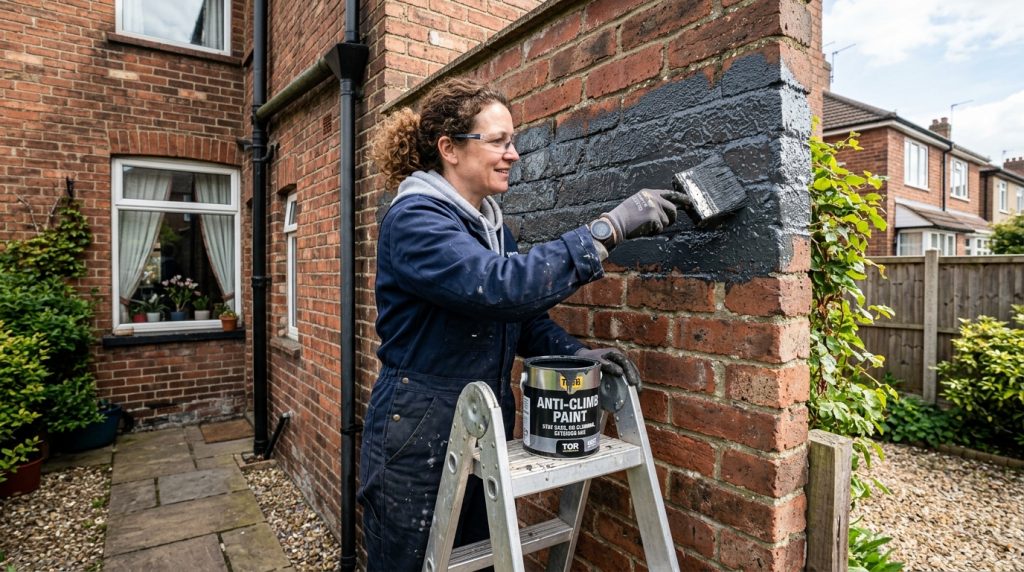
Anti-Graffiti Paint vs Anti-Climb Paint – Are They the Same?
Anti-graffiti paint and anti-climb paint are both protective coatings used on walls, fences, and public structures, but the way they function—and the problems they solve—are quite different.
Anti-graffiti paint is designed to protect surfaces from vandalism.
When applied, it forms a clear or slightly tinted protective barrier that prevents spray paint, markers, ink, and other substances from bonding permanently with the underlying surface.
If graffiti does appear, it can usually be removed easily using water, mild solvents, or pressure washing without damaging the original wall finish.
The coating itself dries into a solid, hard layer, much like a typical protective sealant.
Anti-climb paint, on the other hand, is a security deterrent rather than a surface protector. It is intentionally formulated to remain thick, greasy, and non-drying.
When someone attempts to climb a wall, pipe, or fence coated with it, the slippery surface prevents them from getting a proper grip.
The paint also transfers easily onto hands and clothing, which further discourages climbing attempts.
Because of this messy nature, anti-climb paint is usually applied only on upper sections of walls or structures, along with visible warning signs.
Another major difference lies in where and how they are used.
Anti-graffiti coatings are common on public buildings, schools, transit stations, and commercial storefronts, where walls are frequently targeted by vandals.
Anti-climb paint is more common on perimeter walls, security iron fences, warehouses, factories, and residential boundaries where unauthorized entry is a concern.
In short, while both coatings help protect property, anti-graffiti paint protects surfaces from vandalism, whereas anti-climb paint protects property from trespassing and intrusion.
| Feature | Anti-Graffiti Paint | Anti-Climb Paint |
|---|---|---|
| Primary Purpose | Prevents graffiti from sticking to surfaces | Prevents people from climbing walls or structures |
| Surface Finish | Dries into a hard, clear protective coating | Remains greasy, slippery, and non-drying |
| How It Works | Creates a barrier so graffiti can be cleaned off easily | Eliminates grip and transfers onto hands/clothes |
| Typical Applications | Public buildings, bridges, storefronts, schools | Boundary walls, fences, pipes, industrial buildings |
| Maintenance | Graffiti can be washed off with water or solvents | Requires reapplication if removed or weathered |
| User Experience | Clean and dry surface | Sticky, messy surface designed to deter climbing |
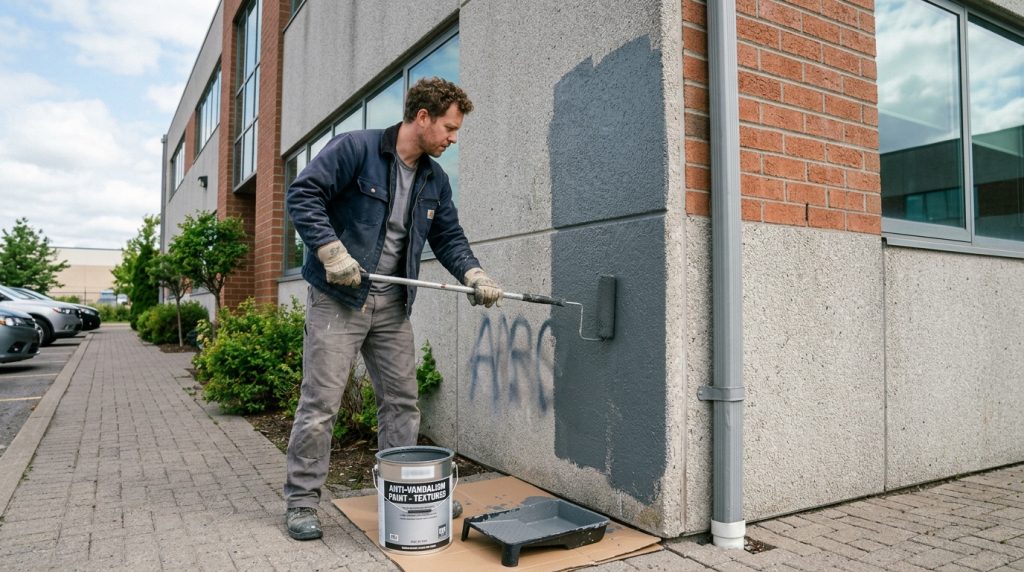
Is a Permit Required for Anti-Vandal Paint? + Simple Removal Tips
In most cases, you do not need a permit to apply anti-vandal or anti-climb paint on your own property.
Homeowners and businesses commonly use it as a low-cost security measure to discourage trespassing and vandalism. However, there are a few important legal and safety guidelines to keep in mind before opening the paint can.
First, many local authorities require that clear warning signs be posted wherever anti-climb paint is used.
The reason is simple: the paint remains permanently greasy and can easily transfer to hands, clothing, or tools. Warning signs help prevent accidental contact and inform anyone approaching the wall that the surface is intentionally treated.
Second, the paint should only be applied at a certain height—typically above 2 to 2.5 meters (around 6.5 to 8 feet) from ground level.
This ensures that pedestrians, delivery workers, children, or pets are unlikely to touch it accidentally. Applying the coating lower than the recommended height could potentially create liability issues if someone gets stained or injured.
There may also be local regulations in certain cities or residential communities that restrict how and where security coatings can be applied—especially on boundary walls facing public sidewalks.
If you live in a housing society or managed community, it’s wise to check with the local association and neighbours before applying.
Removing anti-vandal paint
If at times the anti-climb paint doesn’t work out as you expected, or if you accidentally get some of it on clothing, tools, or nearby surfaces that don’t need to be painted, you may eventually need to remove it.
But, since anti-climb paint is specifically designed not to dry and remain greasy, cleaning it up can be messy and may take several cleaning attempts to fully remove it. Worry not, it’s still manageable with the right approach and cleaning materials.
Removing anti-climb paint from clothing can be easier using a common solvent such as mineral spirits, turpentine, or a commercial degreaser. Apply the solvent and wash the clothing separately to ensure that the paint has been removed.
On walls, concrete, brick, and similar surfaces, removing anti-climb paint can be messy.
But you can still apply absorbent powders, such as baking soda or cat litter, which can help pull oil out of the pores before washing with warm water and a strong dish detergent to remove the remaining oily residue.
Other Related FAQs:
Where to buy anti-climb paint?
Anti-climb paint (also known as non-drying paint, anti-intruder paint, anti-vandal grease) can usually be purchased from industrial paint suppliers, security product stores, and large online retailers.
In the U.S., it’s commonly available through specialty coating suppliers and online marketplaces like Amazon, Grainger, or industrial paint websites. Some professional paint stores also stock it or can order it on request.
A few well-known brands include Coo‑Var, Flag Paints, Blackfriar, and Watson Coatings. These manufacturers produce specialized coatings designed to deter intruders by making surfaces extremely difficult to climb.
Before buying, check that the product includes warning signage and proper application instructions, which are often required when using anti-climb coatings.
How often should anti-climb paint be reapplied?
Anti-vandal paint is typically dark-colored and formulated with a thick, oily base combined with specialized pigments, which prevents the coating from drying or hardening.
Because of this unique composition, the surface remains greasy and slippery for an extended period—often up to three years before a fresh application may be needed.
Another advantage is that recoating is simple. In most cases, you can apply a new layer directly over the existing one without removing the underlying coats, making maintenance quick and relatively hassle-free.
Can you make your own anti-climb paint at home?
Technically, you can create a basic DIY version of anti-climb paint, but it’s important to understand that homemade mixtures usually won’t perform as well or last as long as commercial products specifically designed for security use.
A simple DIY approach involves mixing thick, sticky substances such as petroleum jelly (Vaseline) or bitumen-based paint with heavy-duty grease. These materials help create a surface that remains oily and difficult to grip, which is the primary goal of anti-climb coatings.
Some people also add coarse sand or fine grit to the mixture to increase the discomfort and instability for anyone trying to climb.
The Bottom Line
Rather than relying on alarms or electronics, anti-vandal paint works on a much simpler principle: make the surface so persistently slippery and messy that climbing it becomes impractical.
The primary purpose of anti-climb paint is to create a physical obstacle (on property boundaries, walls, pipes, drainpipes, and other structures) for anyone attempting to scale a barrier to gain unauthorized access.
Just make sure that you apply it correctly and put appropriate signage to warn people that the surface has been treated with anti-climb paint, helping prevent accidental contact and ensuring the deterrent works as intended.
Share the post "What is Anti Climb Paint – Application Tips & Usage"


With Radon warnings and sealers out there, it can send your head into a spin about whether this is all Read more

We all love MDF for our various projects, including furniture and cabinets. After all, it's cost-effective compared to other wood Read more

For those who want their walls to have a unique appearance, glow-in-the-dark paint is one way to express creativity. As Read more

For over two hundred years, the Valspar brand has been associated with quality. Starting in 1806, the company grew into Read more

Jack Luis is a semi-retired painter who loved painting his clients’ ideas on their walls.
He had worked as a painter for over a decade serving customers in areas such as Charleston, Mount Pleasant, Beaufort, and Georgetown, SC (South Carolina). Today in his free time, he likes to read and write about the newer techniques implemented in his profession. You may read more about him here or get in touch with him here.