

I remember the early days when my father, as a painter, did not have many options for spraying the cabinets quickly. But the story is different these days.
We now have HVLP paint sprayers that offer several advantages.
Whether you are a DIYer or a professional painter, HVLP paint sprayers give you the flexibility for precise and adjustable painting without tons of overspray and wasted paint.
Especially if you’re looking to paint, stain, or polish your kitchen and bathroom cabinets getting a sprayer like this can help a lot.
Best HVLP Paint Spray Guns for Cabinets
When it comes to painting cabinets or handling small woodworking projects, having the right HVLP (High Volume, Low Pressure) paint spray gun can make all the difference.
However, with a plethora of brands competing in the market, it’s important to do your homework to find the perfect fit for your needs.
Fortunately, I have already tested and reviewed a few top-rated HVLP spray guns, considering factors like performance, ease of use, versatility, and value for money.
So, by going through the comparison of some leading sprayers on the market you’ll get a clearer idea of which one best suits your needs.
1- Wagner Control Spray
- SUPERIOR PERFORMING HVLP SPRAY GUN: This HVLP sprayer utilizes a...
- USE WITH A VARIETY OF MATERIALS: Applies thin materials such as...
- SUPERIOR NOZZLE: The sprayer comes with a versatile nozzle that can be...
*Last update on 2026-03-26 / Affiliate links / Images from Amazon Product Advertising API
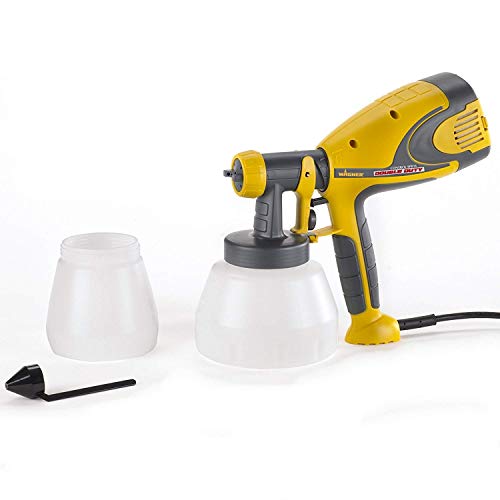
Wagner 0518050 Control Spray is a phenomenal double-duty paint sprayer I loved using in my kitchen for spraying cabinets.
With its powerful HVLP (High Volume, Low Pressure) air power technology, it can help you spray a variety of paint materials, such as thinned latex paints, sealers, stains, varnishes, lacquers, and urethane.
One good thing I liked most about this Wagner device is its two-stage indoor/outdoor rated air turbine which offers an uninterrupted continuous flow of material and air.
Due to this, you can achieve professional fine finishes – no matter whether you are painting your kitchen cabinets or staining your deck, patios, and fences.
Great for various DIY projects, the complete kit includes a sprayer machine, 2 material cups (a 1-quart container for smaller interior work and a 1.5-quart container for larger exterior work), and a viscosity measuring cup.
If you want to get your paint job done quickly and with professional-looking even coverage – this is a spray gun for you.
| What I Like | What I Don’t Like |
|---|---|
| • Easy to set up and clean • Can spray up to 8.0 gallons per hour • Easy to control the volume of material flow • Allows spraying in 3 patterns (round, horizontal, or vertical) | • Not ideal for larger projects |
2- Vonforn HVLP Paint Sprayer

- 【4 Nozzles & 3 Spray Patterns】VONFORN 700W paint sprayer equipped...
- 【Unique Blowing & Cleaning Functions】Before spraying, you can use...
- 【Easy to Use & Clean】The paint sprayer can be easily assembled...
*Last update on 2026-03-26 / Affiliate links / Images from Amazon Product Advertising API
The VONFORN VF803 700W HVLP Paint Sprayer is a solid choice for DIY enthusiasts and professionals alike.
One of the things I love about it is the versatility—with four different nozzles (1mm, 1.5mm, 2mm, and 3mm) and three spray patterns (horizontal, vertical, and circular), I can adjust it based on the project I’m working on. Plus, the adjustable flow control helps me avoid overspraying or wasting paint.
Another feature that really impressed me is the blowing and cleaning functions. Before painting, I can use the built-in dust-blowing joint to remove debris from the surface, which really helps with getting a smooth finish. Cleaning up afterward is just as simple—I just connect it to a faucet, and the paint residue flushes out easily.
Even if you’re a beginner, this sprayer is super easy to use and assemble. I had it up and running in minutes after reading the manual, and cleaning it afterward was straightforward with the included brush and nozzle needle. The package also comes with extra accessories like paint filters and a viscosity cup, which is a nice touch.
Overall, the VF803 is a solid, user-friendly paint sprayer that delivers professional-looking results. It’s saved me a ton of time and with responsive customer support (within 18 hours), I feel confident knowing help is available if I ever need it.
If you’re looking for an affordable, efficient, and easy-to-use paint sprayer, this one is definitely worth considering.
| What I Like | What I Don’t Like |
|---|---|
| • Easy to assemble, use, and clean • Ergonomic design with a soft handle • 3 ways precise spray pattern settings • Adjustable flow control knob to control the paint flow • Easy to spray edges, corners, and broad interior surfaces | • A bit noisy • Heavy once loaded |
3- HomeRight Finish Max Sprayer
- PAINT SPRAYER FOR COUNTLESS DIY PROJECTS: The HomeRight Super Finish...
- ADJUSTABLE SETTINGS TO SUIT ANY PROJECT: You can adjust the air cap to...
- MORE POWER=SPRAY MORE MATERIALS: Offers 450 watts of powerful spraying...
*Last update on 2026-03-26 / Affiliate links / Images from Amazon Product Advertising API
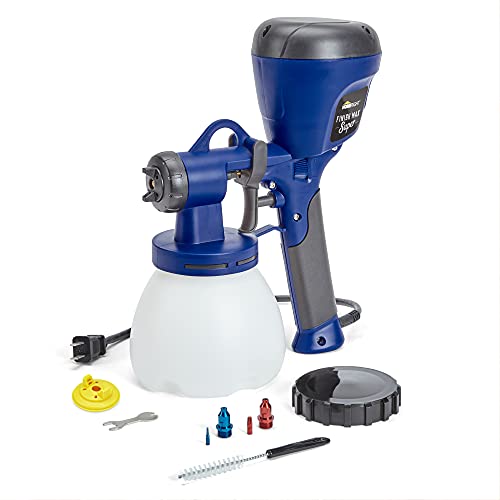
HomeRight Finish Max Super sprayer is ideally designed to complete a range of different DIY paint projects with less thinning and hassle than other hand-held paint sprayers.
This newly designed HomeRight sprayer is easy to set up and clean (thanks to its pickup tube and cup vent).
One thing that I like most about this sprayer is that it comes with a turbine motor, which means that you do not need to have an air compressor to spray the material.
No matter if you need to spray your cabinets, decks, furniture, walls, or fences, the Super Finish Max does it with its advanced multiple spray settings.
Not only for various household painting and staining projects, but it’s also an ideal sprayer for crafts, no matter what materials you use, latex paints, enamels, primers, clear sealers, polyurethane, stain, or varnishes.
| What I Like | What I Don’t Like |
|---|---|
| • Easy to use and clean • 450 watts of power to provide a thicker spray • Volume control knob for customization of paint flow • 2 different air caps to spray with varied fine patterns • 3 interchangeable spray tips for spraying different materials | • Needs a bit of practice |
4- TCP Global HVLP Spray Gun Set
- Three Nozzle Sizes: The set includes a 1.0mm, 1.4mm, and 1.8mm...
- Full Control System: The spray guns feature adjustable knobs for...
- Consistent Coverage: The spray guns are designed to provide smooth,...
*Last update on 2026-03-26 / Affiliate links / Images from Amazon Product Advertising API
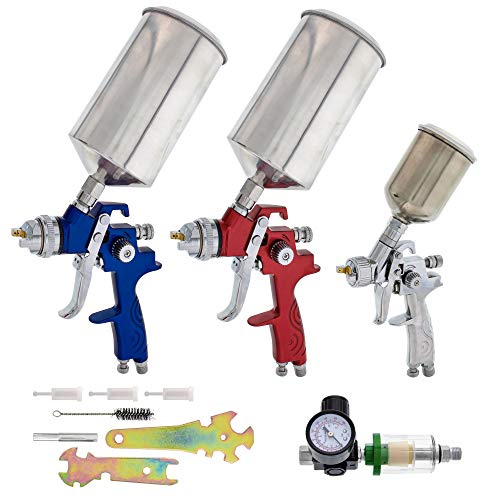
The TCP Global G6600 Series HVLP Spray Gun Kit covers everything from fine detail work to heavy-duty coatings, making it an excellent all-in-one solution.
Unlike other budget-friendly sprayers, this 3-gun set doesn’t cut corners. It comes with stainless steel needles, nozzles, and air caps, ensuring durability and a consistently smooth spray pattern. The fully atomized spray means you get a professional-grade finish every time, without streaks or uneven coverage.
What I really appreciate about this kit is its versatility:
- The 1mm tip detail gun is perfect for those tight areas and precise touch-ups.
- The 1.4mm fluid tip gun works great for base coats, clear coats, and medium-viscosity materials.
- The 1.8mm fluid tip gun handles primers, oil-based paints, and even heavier coatings with ease.
Another big plus is the easy-to-follow instruction manual, which made setup straightforward. And with a one-year warranty, it’s a risk-free investment.
Whether you’re tackling cabinet painting, furniture refinishing, auto painting, or home improvement projects, this kit delivers premium performance without the premium price tag. It’s been an absolute game-changer for my DIY painting projects, definitely worth considering if you want quality and affordability in one package.
| What I Like | What I Don’t Like |
|---|---|
| • Fully atomized spray patterns • Best for getting a professional finish • Premium features without the premium price • Easy to use and clean with an included cleaning brush | • Dripping paint and packaging issue |
5- Fuji Semi-Pro 2 HVLP Spray System

- Professional non-bleed Spray Gun with Adjustable Pattern Fan Control
- 1.3mm Air cap set installed
- 1Qt Bottom Feed Cup
*Last update on 2026-03-26 / Affiliate links / Images from Amazon Product Advertising API
Equally useful for workshops or residential use, The Fuji Spray Semi-PRO 2 Model is an ideal, most powerful 2-Stage Spray System on the market.
The sprayer offers you a perfect combination of versatility and performance to use it effortlessly for spraying cabinets, walls, ceilings, doors, fences, shutters, and many other furniture pieces.
It comes with varied air-cap sizes that enable you to spray various materials with different viscosity levels with little dilution (be it stains, latex paints, or bathtub coatings)
With this super-powerful 1400-watt 2-stage bypass motor machine, all you can expect is a professional-looking finish with no fuss at all.
Most importantly, the sprayer system is super easy to disassemble, allowing you to clean it up quickly after usage.
With all the premium features, it’s no wonder that the Fuji Semi-Pro 2 HVLP Spray System 2202 is on the higher end of the spectrum regarding pricing.
However, since it’s a kind of durable sprayer system that can be used by professionals as well as weekend warriors, start-up businesses, and serious hobbyists for years to come, its high price tag is justified for customers.
| What I Like | What I Don’t Like |
|---|---|
| • Lightweight and portable • Quick-change turbine filters • Knob to get adjustable the pattern size • Metal Turbine case with a handy gun holder • 25ft Hose includes air control valve to reduce overspray | • Overpriced • Need some patience and practice |
How to Use an HVLP Paint Sprayer Gun?
In general, every HVLP paint sprayer comes with its instructions. Still, if you’re new to these devices, it will help to look at the tips and processes below.
Step 1- Move Objects out of the Blast Zone
Whenever you use your HVLP paint sprayer for spraying cabinets, you want to ensure that the area is well-ventilated so that you aren’t breathing in too many noxious fumes.
Spraying in a closed area can be dangerous. So, if possible move your furniture out and use a shelter tent for spraying that will allow you to paint the items without worrying about oversprays.
If you spray indoors, move objects you don’t want to get painted out of the area.
Step 2- Thin Your Paint
Depending on your model, you may need to thin your latex paint for spraying by adding some water. For oil-based paints, you should be using paint thinner.
Most paints in the can are thicker, so it’s good to thin them correctly, or it may come out of the sprayer gun as a messy blob. To know how much to thin the paint, check the manufacturer’s information that came with your device.
Step 3- Connect the Device and Check Air Nozzle
For the next step, assemble the sprayer by attaching the spray gun to the hose and connecting the hose to the turbine or compressor. Connect the device to the power supply and ensure that the hose is placed so that it doesn’t get tangled up and affect the quality of your paint job.
The air nozzle that you use will also have a significant impact on the final look. For this reason, ensure you’ve got the right one you need for the cabinet finishing job before starting.
Step 4- Adjust Air Pressure and Fluid Control
Connect the air nozzle to the spray gun and adjust it according to your needs. The lower air pressure is good for precision, while higher air pressure is good for speed.
Adjusting the fluid control also allows you to manage the look of your finish. You can adjust the cap to change the application pattern (horizontal, vertical, or circular) if needed.
Step 5- Apply Paint and Clean the Sprayer
Before you start painting your actual project, it’s recommended to do a test spray on a piece of cardboard or scrap material to ensure the sprayer is working properly and to get a feel for how it operates.
Once you have tested and are confident about the spraying technique, start spraying the paint on cabinets using even pressure and patterns throughout your project.
- Hold the spray gun perpendicular to the surface you’re painting, about 6 to 8 inches away.
- Work in small sections, use smooth, overlapping strokes.
- Keep the gun moving at a consistent speed to avoid drips or uneven coverage.
After you have sprayed your cabinets, finish off by cleaning the paint sprayer.
Generally, you can clean the sprayer by rinsing it with the correct cleaning solution—water for water-based paints and mineral spirits for oil-based paints.
Just remove the nozzle and other detachable parts and scrub them thoroughly with a brush to eliminate any leftover paint. Then allow all components to dry completely before reassembling and storing the sprayer properly for future use.

Features to Look in the HVLP Paint Sprayer Machine
Unlike traditional paintbrush and roller, an efficient paint sprayer tool helps you achieve fast and even paint application without leaving any undesirable marks.
The best part is whether you’re a beginner tackling your first DIY project or a seasoned pro looking for a reliable upgrade, there’s an option for everyone.
However, to bring off that desirable finish on your kitchen cabinets, it’s important to consider several essential features in your HVLP paint sprayer…
1- Tight Spray Pattern
If accuracy is what you’re going for, an HVLP paint sprayer with a tight spray pattern is a solution – it comes with a shorter spray area to have more control over your finish.
However, remember that HVLP paint sprayers with plastic tips tend to have larger spray areas and more overspray. So, it may be worth spending a little extra for a better product that uses brass needles and tips instead of plastic. While these tend to be a bit pricier, they hold up better than plastic devices and generally release less overspray.
In general, if you’re serious about painting and want consistent results (for cabinetry, automotive, and professional painting), brass is worth the investment. But for occasional use and light-duty DIY work, plastic can still do the job.
Also remember that many HVLP sprayers offer multiple spray patterns—horizontal, vertical, and circular—allowing you to tailor your application to different surfaces and project needs. Adjusting the spray pattern ensures an even finish while reducing overspray and waste, particularly in detailed areas like corners and edges.
Some models also feature a pressure control dial for precise adjustments, giving you better control over paint flow and coverage. Practicing on test surfaces helps refine your technique and build confidence before painting cabinets. By selecting the right spray pattern, you can improve both the quality and efficiency of your project.
2- Type of Paint Materials
HVLP sprayers work best with thin or well-thinned paints for smooth, even coverage. For best results, always check the manufacturer’s viscosity recommendations and use a viscosity cup to ensure proper thinning before spraying.
The best paints you can use in HVLP sprayers include lacquers, which offer a smooth finish and fast drying time, and wood stains and varnishes, which spray easily with minimal thinning.
Oil-based paints provide a durable, glossy finish but may require thinning with mineral spirits, while enamels are ideal for metal and wood surfaces, producing a hard, smooth coat.
Latex paints and thick acrylics are generally too viscous for HVLP sprayers and must be thinned with water or a conditioner. Similarly, chalk and milk paints, commonly used for furniture refinishing, may require dilution to prevent clogging.
Many HVLP paint sprayers can use paint that has not been thinned. Picking them can save tons of time on your home project, but you want to be careful when buying. Be on the lookout for sprayers with metal tips and more powerful needles and turbines inside, as these tend to handle non-thinned paint much easier.
However, heavy-bodied paints, such as textured coatings, and epoxy paints, which can clog the sprayer unless specifically designed for spraying, should be avoided.
3- Nozzle Size, Air Pressure, and Power
Using the correct nozzle size ensures smooth application, controls paint flow, and minimizes overspray, which is essential for detailed cabinet work.
From my experience, I can say that smaller nozzles, like 1.0mm or 1.5mm, are ideal for stains and sealers, while larger sizes, such as 4.0mm, handle thicker paints like primers and latex.
Many HVLP sprayers come with multiple nozzle options, allowing easy adaptation to different projects without extra equipment. Since nozzle size affects spray pattern and coverage, testing different sizes on practice surfaces helps refine your technique.
Most HVLP sprayer guns operate at 10-14 SCFM at 40 PSI, so understanding air pressure requirements is crucial. For versatility, an adjustable sprayer that allows you to modify spray patterns, coverage areas, and paint flow is ideal, ensuring better results across different DIY projects.
Additionally, wattage plays a key role in sprayer efficiency—models with at least 700W provide the power needed to spray thicker materials smoothly and complete projects faster.
4- Light Weight, Portable, and Integrated Storage
When refinishing cabinets, remember that the weight and portability of your HVLP paint sprayer can significantly impact efficiency and comfort. Lighter models, ranging from 5 to 15 pounds, are easier to maneuver, reducing fatigue during extended use.
However, portability isn’t just about weight—compact designs, integrated handles, and detachable components make transportation and storage more convenient. A flexible hose is also essential for reaching tight spaces without moving the entire unit.
Choosing a sprayer with quick assembly and disassembly features further enhances ease of use. Additionally, models with integrated storage allow you to keep needles and hoses organized, streamlining setup.
5- An Efficient and Fast Cleanup Process
No matter whether you are using your HVLP paint sprayer gun for indoor cabinets or for outdoor furniture, fences, or decks, an efficient and faster cleanup process is essential. This also means choosing a model with user-friendly cleaning features is crucial for preventing clogs and ensuring your sprayer’s longevity.
Look for sprayers with easy-to-remove nozzles and containers, as these simplify the process. Many models also include disassembly options and cleaning tools like brushes and needles, making thorough maintenance easier.
Using disposable paint filters can help prevent clogs, reducing residue buildup. Some sprayers even offer dust-blowing functions for pre-spray surface cleaning, further improving efficiency.

HVLP vs. Airless Paint Sprayer: Which is Better for Cabinets?
When planning to purchase, you may come across an HVLP paint sprayer and an airless paint sprayer system.
If you aren’t sure which one you need for your project, let’s take a look at what each of these two machines does so that you can get a better idea.
HVLP Paint Sprayers:
With lower PSI, these paint sprayers aren’t the best for speedy or large projects and don’t handle thicker paints well. For this reason, they are generally used for small-scale projects, cabinetry work, and wood furniture where detail is critical.
Some notable advantages of HVLP paint sprayers are:
- Less overspray leads to more precise work
- It can be used with most thin paint types, including lacquer and stains
- It allows you to spray up to six inches away for better safety and precision
Airless Paint Sprayers:
Unlike HVLP paint sprayers, airless paint sprayers work at high volumes to apply even coats of paint across large surfaces. These devices are frequently used outside on large projects such as painting fences and decks. But they are also great at painting interior walls and ceilings.
Of course, airless paint sprayers come with their advantages, such as:
- It can be used with thicker paints
- The versatile application makes it suitable for both indoor and outdoor work
- Applies even coats over much larger surfaces than HVLP spray guns
So, if you are after a small project that depends on precision (such as painting your cabinets, windowsills, a chair, or a small table), you want to use an HVLP paint sprayer. But if you are after something a bit more speedy (such as for painting your outside shutters), airless paint sprayers are the way to go.
The Bottom Line
Investing in an HVLP paint sprayer could be the solution you’ve been searching for to elevate your next significant project, offering top-notch finishes on smaller-scale work while remaining competitively priced.
Hopefully, with the guidance provided in this guide, you’ll be well-equipped to purchase and utilize your machine promptly, ensuring the efficient completion of your cabinet painting tasks.
Don’t hesitate any longer—take action now and find the perfect paint sprayer to meet your needs after considering essential factors like nozzle sizes, weight, spray patterns, and the type of paint you’ll use for your cabinets.
Share the post "The 5 Best HVLP Sprayers for Wood Cabinets"


From building furniture and refurbishing existing furnishings to touching up the doors, tables, and other wooden pieces in your home, Read more

Getting the best paint job means more than using the right paint. In addition to having good brushes and rollers, Read more

You are in the middle of sanding your walls, and you realize that there are still many more pieces of Read more

Got a DIY spray painting project that you’re anxious to get rightly done? Maybe a paint spray shield (or a Read more

Jack Luis is a semi-retired painter who loved painting his clients’ ideas on their walls.
He had worked as a painter for over a decade serving customers in areas such as Charleston, Mount Pleasant, Beaufort, and Georgetown, SC (South Carolina). Today in his free time, he likes to read and write about the newer techniques implemented in his profession. You may read more about him here or get in touch with him here.